


Introduction
In an article published by the Washington Forum on India some time ago, Raviya Suri argued for a shift in the Indian nuclear doctrine from a position of “No First Use” — which implies the non-employment of nuclear weapons for preempting a conflict, or the elimination of the opposing number’s nuclear arsenal in what has been termed as a “splendid first strike”1 — to a doctrine of strategic ambiguity, where India makes no promises of no first use in the national interest. The author, in their argument, framed the national interest served through the strengthening of deterrence. In their submission, Suri highlighted what they called “flaws” in India’s bid of deterring Pakistani aggression through sub-conventional warfare techniques.2
Such a policy change, however, warrants scrutiny. I argue that the adoption of this proposal, with the objective of deterring Pakistan’s sponsorship of sub-conventional warfare in places like Jammu and Kashmir, is disproportionate and unlikely to be successful. I make this claim by giving cognisance to the incredibility of a nuclear threat issued by New Delhi to stop insurgent attacks in a localised region. Given the fragility that characterizes Indo-Pakistani crisis stability and the present posturing of both India and Pakistan’s nuclear forces, I also argue that an Indian shift of nuclear doctrine to a position of strategic ambiguity compounds the risk of a nuclear exchange between the two countries in the next crisis they engage in. I make this claim by drawing attention to Pakistan’s understanding of its security environment and its nuclear arsenal as the lynchpin of its defence. As a result, I will highlight in the conclusion of this article that a shift from the NFU is not just ineffective, but also morally irresponsible given the millions of lives it would put at risk.
This essay will thus proceed in the following manner. First, it will describe the Indian nuclear arsenal in order to highlight its purpose, which is the sole deterrence of the enemy employment of weapons of mass destruction. Second, it will distinguish between Indian nuclear doctrine and nuclear posture to claim that the country’s conventional forces do not seem to be as restrained as New Delhi claims them to be. Third, it will analyse Pakistan’s understanding of its security environment to highlight what it is trying to deter through its nuclear arsenal. In this vein, it will also describe the state of Pakistan’s nuclear forces and contend why an Indian shift to an ambiguous position risks making the case of either increased nuclear brinksmanship or that of “use it or lose it” for Pakistan through the mechanism of the security dilemma.
A Note on the Indian Nuclear Arsenal
Before making an argument on the subject of the Indian nuclear arsenal, I believe it important to establish the objective that underlies this body of weaponry. India’s nuclear doctrine, adopted in 2003, explicitly assigns no warfighting capability to the country’s nuclear capabilities, and instead deems them only deterrent value. As its first formulation in 1998 put it, “The fundamental purpose of Indian nuclear weapons is to deter the use and threat of use of nuclear weapons by any State or entity against India and its forces. India will not be the first to initiate a nuclear strike, but will respond with punitive retaliation should deterrence fail.”3
There is a wealth of scholarship present on the subject of India’s doctrinal positioning on nuclear weapons, much of which is indicative of the country’s explicit refusal to employ nuclear weapons first in the event of an exchange with a Nuclear Weapons State (NWS).4 In a similar vein, its nuclear arsenal has never been prepared in a manner such that its weapons could have battlefield employability.5 As Gen. V.P. Malik, the Indian Chief of Army Staff, said after Operation Shakti in 1998, “Nuclear weapons are not military weapons. So the first thing I’d like you to notice is that these are political weapons and they must be viewed as such, they are today weapons to deter others from using this weapon—those who have it.”6
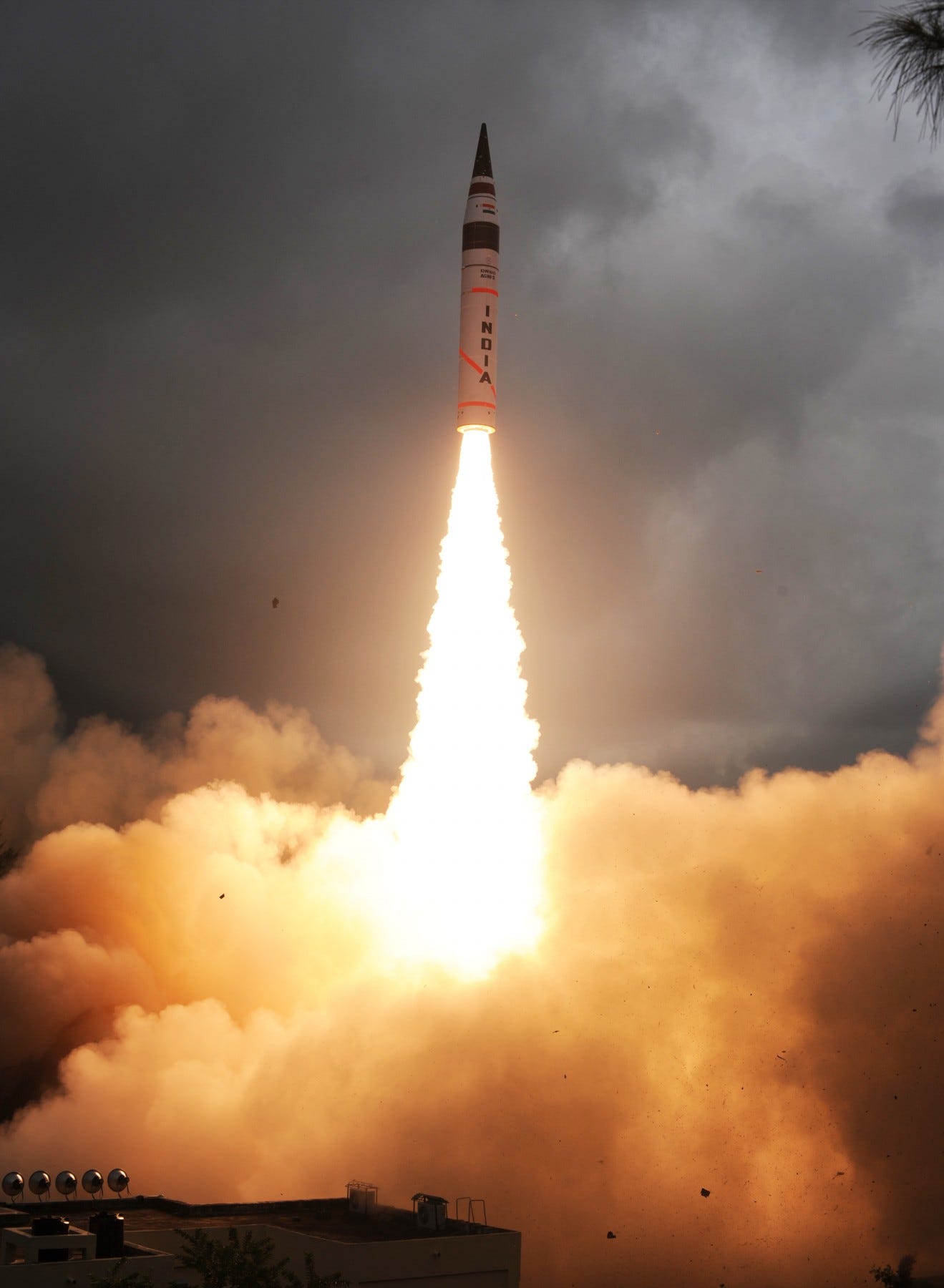
Indian Agni-V ICBM. Courtesy of Defence Research and Development Organisation.
Earlier examinations of India’s nuclear posture indicate that such an arrangement has been rejected by the Indian political class and its defence establishment out of three separate considerations. First, which Suri endorses, is that India would claim the higher ground of morality as opposed to Pakistan with its Full Spectrum Deterrence (FSD) doctrine out of sheer ideological exceptionalism.7 Second, because India’s civilian dominance over defence matters has precluded the military’s custodianship over pre-mated nuclear weaponry, meaning that the arsenal’s warheads are separated from their delivery mechanisms and can only be authorised under the express command of the Strategic Forces Command’s Political Council, which is chaired by the Prime Minister.8 Third, that India’s conventional military dominance over Pakistan, combined with its ability to conduct a “defence-in-depth” conventional strategy against China in the event of a conflict, makes a first-use doctrine to ensure Indian survival redundant.9 Consequently, the country’s security environment does not indicate the need for an asymmetric escalation posture that follows the “escalate-to-deescalate” doctrine adopted by the likes of Pakistan, France, or as Suri indicates, Russia.
Why Indian Offensive Nuclear Threats are Unlikely to Succeed
For the purposes of this essay, we now focus specifically on the third point here. India, with its conventional military forces, does not need an asymmetric escalation posture to offset conventional existential threats from its neighbours. Does it need one to to compel the cessation of sub-conventional warfare in places like Jammu and Kashmir? The answer here is no, for the threat of a first nuclear strike to deter support for insurgent attacks is inherently incredible. As Schelling put it, the destructive capabilities of nuclear weapons separate them from other classes of conventional weaponry, which can be extrapolated to consider their use for offensive purposes unique, and often without credibility.10 Backing this, work by Sechser and Fuhrmann on the incredibility of offensive nuclear weapons indicates that an offensive nuclear threat issued by India against Pakistan is unlikely to work seeing the balance of power between them. Specifically, we must consider the fact that India has superiority in terms of conventional military forces prepared under the Cold Start Doctrine to threaten Pakistan with a “penetrate-and-hold” attack, thus not necessitating nuclear weapons usage. Similarly, Downes and Glaser pin down the effectiveness of an offensive nuclear threat to six factors, the most important ones for us being the relative interests of the compeller; the conventional military balance between the compeller and the target state; and the strength of norms that constrain the compeller’s use of nuclear weapons.11 India suffers on all three fronts: its relative interest with respect to Pakistan’s is not so extraordinary that it would constitute an existential threat, it has the conventional advantage against Pakistan (as was previously mentioned); and the consistent assertions on nuclear weapons only having political value by military officials, civilian policymakers, and political leaders makes it harder to believe a compellent nuclear threat. Consequently, a simple shift in doctrine towards indicating a nuclear response, or “leaving it to chance,” will probably have little chance at compelling anything whatsoever.
Indian Nuclear Doctrine and Posture: a Dangerous Divergence
Suri’s description of Indian nuclear strategy does not give much consideration to its force posture.12 Scholarship points towards divergence. India’s nuclear arsenal has been configured in such a way that its ability to attempt a “splendid first strike” becomes an inescapable issue. This we understand through four elements. First is the country’s implementation of Multiple Independently Targetable Reentry Vehicles (MIRVs) — a classic component of a counterforce doctrine given their efficiency at destroying multiple targets while simultaneously making it harder for Ballistic Missile Defence (BMD) systems to track and defend against them13 — on both its land and sea-based ballistic missiles.14
Second is the fact that the revolution in reconnaissance technology has reached India, meaning that the country has meaningfully improved its Intelligence, Surveillance, and Reconnaissance (ISR) capabilities in a way that has become evident to Pakistani observers. A counterforce strategy requires that the engaging state be able to target and kill most of its enemies’ strategic military assets in its attacks. India today possesses one of the largest remote sensing and communication satellite systems in the world, which can be easily modified for dual-use functions. Its RISAT and CARTOSAT systems, for example, become critical as they are able to produce high-quality images that are critical for identifying strategic assets.15
Third, we must note that India, with the development of the sea-based leg of its nuclear triad, can no longer keep all of its weapons in a strictly disassembled state under civilian custody. The development of “canesterised” weapons — pre-mated weapons sealed in the Vertical Launching Systems (VLS) of its Arihant-class submarines — and their active deployment in a bid to reach a Continuous-At-Sea Deterrent (CASD) stage not only raises new challenges for assertive civilian command-and-control over the weapons, but also raises questions of how consistent the country’s posturing is with its idea of “responsible” no-first use.16
Fourth, that the Indian military (specifically the Indian Air Force), by recognising the dual-use status of Pakistan’s tactical nuclear systems such as the Nas’r missile systems, does not intend to ask for pre-clearance from PMO before targeting them for destruction. As Vipin Narang wrote:
“In discussions with retired Indian Army and Air Force officers, it has become clear that in a conventional conflict with Pakistan or China, India’s conventional operators consider any fixed nuclear target or any mobile missile launcher, in the field or on a base, as legitimate targets which they could strike without prior political clearance. In both cases, India’s Air Force or Army may not be able to, or may not care to, determine whether the systems they are targeting are nuclear or conventional. Indeed, some have gone so far as to say that they intend to degrade the adversary’s nuclear systems at the outset of a conventional conflict, and that this strategy would not otherwise require political authorization, despite the enormous strategic consequences.”17
Consequently, potential future conflict between India and Pakistan — which is not unlikely seeing recent attempts by the former to carve space to wage conventional operations against the latter — could escalate to an extent such that dual-use assets such as low-yield Tactical Nuclear Weapon (TNW)-carrying Transporter-Erector-Launchers (TELs) are targeted through conventional military means, either unintentionally or intentionally to reduce its nuclear warfighting capabilities.18
What this description about India’s nuclear posture reveals is that there exists, or appears to exist, a divergence between India’s simplified nuclear doctrine of strict no first use and its actual operational posture, which is potentially aggressive, evolving, and risks triggering misperceptions in Rawalpindi that New Delhi possesses counterforce ambitions. This dynamic is deadly, and as the next section of this essay will argue, risks unleashing forces of nuclear brinksmanship that neither of these countries will be able to control, thus causing catastrophe.
Pakistani Nuclear Doctrine and Posture
Thinking about Pakistan’s perception of the divergence of Indian nuclear doctrine and posture warrants consideration of its own strategic and operational policies on the handling and employment of nuclear weapons. As Suri themselves identify, Pakistan’s Full Spectrum Deterrence (FSD) doctrine aims to explicitly offset India’s conventional superiority by producing nuclear systems with battlefield utility, releasing these to the military’s custody without civilian oversight, reserving the right to a nuclear first strike as and when it sees fit, and explicitly declaring their use to be legitimate in order to deter conventional aggression from India. As Lt. Gen. Kidwai, former commander of Pakistan’s Strategic Plans Division, said:
“Nuclear weapons are aimed solely at India. In case that deterrence fails, they will be used if:
India attacks Pakistan and conquers a large part of its territory (space threshold);
India destroys a large part either of its land or air forces (military threshold);
India proceeds to the economic strangling of Pakistan (economic strangling);
India pushes Pakistan into political destabilization or creates a large-scale internal subversion in Pakistan (domestic destabilization).”19
Pakistan’s nuclear posture, unlike India’s, maintains close symmetry with its declared strategy, and maintains credibility (at least on the first and second thresholds Kidwai lays out). As scholarship indicates, Pakistan possesses a multitude of battlefield nuclear weapons under military custody that can be deployed on TELs and launched in short order.20 Analyses also show that Pakistan has also had a history of positioning TNW batteries on the Indo-Pakistani border during times of crisis in order to deter — or respond to should deterrence fail— an Indian conventional response.21 This essay will not comment at length on Pakistan’s present development of its own nuclear triad to increase the survivability of its arsenal, but will only argue that it sees its nuclear forces as the lynchpin of its defence against India and deems it paramount importance for its own survival, especially given its lack of geographical depth.22 Even in the event that deterrence does fail and India does deploy ground troops, some Pakistani military thinkers genuinely believe that they can get away with a TNW strike against India and get away with it.23 After all, can a country that has promised nuclear restraint credibly commit to killing millions of its neighbour’s civilians alongside risking the lives of its own citizens due to nuclear fallout in the event that a nuclear strike occurs against its forces as they are advancing into enemy territory, on the enemy’s own soil? These are considerations that were not addressed by Suri in their article and warrant some consideration.
A Deadly “Agree-to-Disagree” Dynamic
Our discussion brings us to another question. Is the Pakistani nuclear strategy an effective one? There is a difference in opinion here between the Indian and Pakistani defence establishments. Looking back at the war between the two countries in May last year, one could argue that Pakistani deterrence worked against India last year seeing how military operations were largely limited to aerial warfare and rocket bombardment and did not involve the deployment of land forces.24 One could, however, also argue that deterrence did not hold given that Pakistan could not stop India from striking military infrastructure, including an air base that was only a mile away from Pakistan’s Strategic Plan Division headquarters (which manages its nuclear arsenal). India’s defence community, in the follow up of this aftermath, has argued consistently that the Pakistani nuclear deterrent is not a credible one.25 This gives India an incentive to test and push the limits of the deterrent. Experts are thus concerned that the next confrontation between these countries may involve India engaging in a land incursion into Pakistani territory in accordance with the CSD’s “penetrate-and-hold” strategy.26
Given this difference of understanding, I also propose a thought experiment. How would Pakistan react to a hostile NWS against which it has lost four wars, has only been recently engaged in a skirmish that did not turn out to be an existential crisis because of its nuclear arsenal, and currently sees preparing for what appears to be a “penetrate-and-hold” attack that can only be deterred by this strategic force?27 Furthermore, what would it make of a situation wherein it sees the Indian nuclear force turning towards a preemptive counterforce tendency, with a doctrine that indicates otherwise? This is the groundwork of the aforementioned catastrophe.
Preparing for the Worse Makes for the Worse: a Self-Fulfilling Prophecy
Even in a scenario where India does not intend to launch a “splendid first strike” against Pakistan’s nuclear arsenal to follow it up with a penetrative ground assault, the mere perception — or misperception — of this could drive Pakistan to take drastic steps to increase the survivability of its nuclear weapons and engage in nuclear brinksmanship in a bid to deter Indian aggression. Scholarship has argued in favour of this claim: militaries are more likely to assume the worst in a crisis, prefer aggressive strategies that retain the initiative, and underestimate the probability of nuclear accidents or unauthorised use.28 Consequently, there is a probable risk for us to consider that Pakistan would delegate launch authority to local TNW commanders in the field in the event of a crisis where there is an apparent risk of a decapitation strike through the destruction of Nuclear Command, Control, and Coordination (NC3) structures.
Scholars such as Vipin Narang have also highlighted the fact that Pakistan has weak negative controls that prevent the use of nuclear weapons, alongside strong positive controls that permit the rapid deployment of its nuclear assets in the event of a crisis with India where there the risk of a communications breakdown with NC3 structures is plausible.29 Unlike India with its assertive civilian control over its nuclear arsenal, Pakistan’s civil-military arrangement negates any scenario where the civilian government could rein in the military’s temptations to act aggressively in a crisis. Consequently, the risk of either a local theatre commander or a battery commander taking the initiative to launch a nuclear strike on their own accord is significant and risks aggravation.
Worst Case Scenario: “use-it-or-lose-it”
Having established the risk of nuclear escalation by accident, it is also pertinent for us to consider the possibilities of a nuclear exchange even if the SPD maintained sufficient control over its nuclear arsenal in a crisis. In a scenario where India possesses its current nuclear posturing and the doctrine Suri recommends, Pakistan will find itself stuck in a dilemma where it faces a threat of an Indian preemptive counterforce attack that uses both conventional and nuclear capabilities to knock out its deterrent. What can Pakistan be expected to do here?
Under such a circumstance, scholars Vipin Narang and Christopher Clary argue that Pakistan will face a “use-it-or-lose-it” situation where it is forced to strike first by launching its assets at the risk of complete — or significant — disarmament.30 Such a crisis scenario, as seen in Threlkeld’s modelling of an escalated Indo-Pakistani conflict following the war in May last year, is probable, thus making the next crisis not a question of “if” but of “when.”31 Implementing a policy like the one Suri recommends, or worse, maintaining the present course of divergence between Indian nuclear doctrine and posture is thus an invitation for a nuclear exchange in South Asia, thus resulting in the reduction of this region to a wasteland.
What does India Need?
As of this moment, what India needs is a serious assessment of the objective of the nuclear arsenal, and more specifically, the limits of the innovation of its nuclear deterrent in relation with Pakistan. India needs to realise that the only feasible option it has that will not trigger a nuclear exchange is a doctrine of No First Use that holds consistency with its posture. Given Pakistan’s sensitivity to the technological and doctrinal shifts of its adversary that may have a bearing on the survival of its nuclear deterrent, India also needs to practice a policy of restraint that does not involve the exercise of conventional violence against Pakistan due to the disproportionate damage it risks incurring as a result of this policy of cost imposition. Other avenues, economic and diplomatic, would have to be explored in order to impose compellence on Pakistan to shut down its support for proxies in the country. So far as the nuclear option is concerned, this needs to be abandoned for strategic and moral considerations.
Conclusion
In conclusion, this essay has attempted to substantiate the claims it made in its introduction. It argues the futility of an Indian doctrinal shift towards an ambiguous doctrine; describes both Indian doctrine and posture to show that these diverge significantly; analyses Pakistan’s security environment to indicate the criticality of the nuclear arsenal to its defence and the figurative mountain of dynamite it sits on; and demonstrates how this is liable to go off even without a change in the nuclear doctrine due to existing dynamics and postures. It further determines that if left unchanged, Indo-Pakistani relations are bound to spiral into a conflict, which is more than likely to go nuclear. Consequently, a failure to act in favour of restraint is just as irresponsible as, if not more than, bullish action towards aggression due to the millions of human lives — regardless of nationality — it would put at stake.
MUSIC CODA
Citations
Clary, Christopher, and Vipin Narang. “India’s Counterforce Temptations: Strategic Dilemmas, Doctrine, and Capabilities.” International Security 43, no. 3 (February 2019): 7-52. https://doi.org/10.1162/ISEC_a_00340.
Suri, Raviya. “Doctrine of Diminishing Returns: Reevaluating India’s No First Use Nuclear Doctrine.” Patrika Journal of International Affairs Volume 1, Issue 1 (July 2026). https://heyzine.com/flip-book/a22ab9d9bc.html.
‘India’s Draft Nuclear Doctrine | Arms Control Association’. Accessed 30 August 2026. https://www.armscontrol.org/act/1999-07/indias-draft-nuclear-doctrine.
See Narang, Vipin. Nuclear Strategy in the Modern Era: Regional Powers and International Conflict. Princeton University Press, 2014. https://doi.org/10.2307/j.ctt6wq00j.8.; Narang, Vipin. ‘India’s Nuclear Strategy Twenty Years Later: From Reluctance to Maturation’. India Review 17, no. 1 (2018): 159–79. https://doi.org/10.1080/14736489.2018.1415289; Tellis, Ashley J. India’s Emerging Nuclear Posture: Between Recessed Deterrent and Ready Arsenal. 2001. https://www.rand.org/pubs/monograph_reports/MR1127.html; Basrur, Rajesh. Indian Nuclear Policy: A Neoclassical Realist Analysis. Studies in Indian Politics, (2025) 13(1), 127-139. https://doi.org/10.1177/23210230251324720; Sagan, Scott D. 2009. Inside Nuclear South Asia. Stanford Security Studies. https://doi.org/10.1515/9780804772419.
Narang, Vipin. “India.” In Nuclear Strategy in the Modern Era: Regional Powers and International Conflict. Princeton University Press, 2014. https://doi.org/10.2307/j.ctt6wq00j.8.
‘Countdown Interviews- General V. P. Malik: 1 – Amitav Ghosh’. Accessed 30 August 2026. https://amitavghosh.com/countdown-interviews-general-v-p-malik-1/.
Sagan, Scott Douglas. 2009. Inside Nuclear South Asia. Stanford Security Studies. https://doi.org/10.1515/9780804772419.
The country’s strong civilian control over military and nuclear resources has been termed as a “Super-PAL” by Ashley Tellis. See Tellis, Ashley J. India’s Emerging Nuclear Posture: Between Recessed Deterrent and Ready Arsenal. 2001. https://www.rand.org/pubs/monograph_reports/MR1127.html.
Narang, Vipin. “India.” In Nuclear Strategy in the Modern Era: Regional Powers and International Conflict. Princeton University Press, 2014. https://doi.org/10.2307/j.ctt6wq00j.8.
Here, we treat an ambiguous nuclear doctrine aimed towards Pakistan as “offensive” because of the desired effects of such. The idea is to posture such that an insurgent attack will trigger a nuclear response that would count as a first in what could potentially be responded to by Pakistan as a second-strike. Given that the Indian punch would be threatened as a first in a nuclear capacity, we treat the threat of such a strike as “compelling” and not “deterring” in a nuclear sense of speaking. As Schelling argues in Arms and Influence, the idea behind compellence is to assure automatic, unbearable punishment which cannot be voluntarily stopped but will autonomously restrain itself if the compeller’s demands are met by the target state. See Schelling, Thomas C. Arms and Influence. Yale University Press, 1966. https://doi.org/10.2307/j.ctt5vm52s.
For reference, the six factors thus identified by Downes and Glaser are the nuclear balance; the compeller’s nuclear vulnerability; the relative interests of the compeller and the target; the size of the compeller’s absolute interests; the extent to which the compeller is constrained by norms against the use of nuclear weapons; and the conventional military balance. See Downes, Alexander B., and Charles L. Glaser. ‘Revisiting the Effectiveness of Nuclear Compellent Threats’. Security Studies 35, no. 2 (2026): 409–45. https://doi.org/10.1080/09636412.2026.2676118.
Force posture, as defined by the Department of Defence, is “the overall military disposition, strength, and condition of readiness of a military.” See Khan, Nasim Abbas. ‘Force Posturing and the Contemporary Security Environment: Options for Industrially Depend’. Air University (AU), 22 June 2020. https://www.airuniversity.af.edu/Wild-Blue-Yonder/Articles/Article-Display/Article/2226481/force-posturing-and-the-contemporary-security-environment-options-for-industria/.
‘The Second Coming of MIRVs - Center for Arms Control and Non-Proliferation’. Accessed 29 August 2026. https://armscontrolcenter.org/the-second-coming-of-mirvs/.
See work done on the study of India’s MIRVing of its land-based Agni-V ICBMs and sea-based K-15 SLBMs. See Diaz-Maurin, François. ‘What India’s MIRV Test Adds to the “Strategic Trilemma” in South Asia’. Bulletin of the Atomic Scientists, 3 May 2024. https://thebulletin.org/2024/05/what-indias-mirv-test-adds-to-the-strategic-trilemma-in-south-asia/.
Shah, Akash. ‘Deterrence under Surveillance: Indian Space-Based ISR Capabilities and Pakistan’s Nuclear Deterrence’. Journal of Security & Strategic Analyses 8, no. 2 (2023): 07–26. https://doi.org/10.57169/jssa.008.02.0201.
Narang, Vipin. ‘India’s Nuclear Strategy Twenty Years Later: From Reluctance to Maturation’. India Review 17, no. 1 (2018): 159–79. https://doi.org/10.1080/14736489.2018.1415289.
Narang, Vipin. ‘Five Myths about India’s Nuclear Posture’. The Washington Quarterly 36, no. 3 (2013): 143–57. https://doi.org/10.1080/0163660X.2013.825555.
For further work done on Indo-Pakistani crisis stability and the risk of the next conflict between these states escalating to the nuclear level, see Threlkeld, Elizabeth. ‘Why the Next India-Pakistan War Will Escalate’. Foreign Affairs, 4 May 2026. https://www.foreignaffairs.com/india/why-next-india-pakistan-war-will-escalate.
Lavoy, Peter. Pakistan’s Nuclear Posture: Security and Survivability – NPEC. 21 January 2007. https://npolicy.org/pakistans-nuclear-posture-security-and-survivability/.
See Tasleem, Sadia. Pakistan’s Nuclear Use Doctrine. 30 June 2016. https://carnegieendowment.org/research/2016/06/pakistans-nuclear-use-doctrine; ‘Pakistan’s Tactical Nuclear Weapons Are Downright Terrifying - The National Interest’. Accessed 3 September 2026. https://nationalinterest.org/blog/reboot/pakistans-tactical-nuclear-weapons-are-downright-terrifying-179247.
“Understanding Pakistan’s Zero-Range Nuclear Strategy.” CAPSS India, 18 August 2023. https://capssindia.org/understanding-pakistans-zero-range-nuclear-strategy/.
Ahmed, Mansoor. Pakistan’s Tactical Nuclear Weapons and Their Impact on Stability. 30 June 2016. https://carnegieendowment.org/research/2016/06/pakistans-tactical-nuclear-weapons-and-their-impact-on-stability.
Kidwai, Khalid, and Peter Lavoy. “A Conversation with General Khalid Kidwai”. n.d. https://carnegieendowment.org/files/03-230315carnegieKIDWAI.pdf
It can be argued here that land forces are a different class of deployment from the usage of airpower altogether seeing the threat of occupation they would impose on the target state and the amount of commitment they would require from the compeller, both of which are precluded through the sole use of airpower. For further reference, see Schelling, Thomas C. Arms and Influence. Yale University Press, 1966. https://doi.org/10.2307/j.ctt5vm52s.
India’s history of engaging in a “cost-imposition” strategy, which started with cross-border commando raids and the one-off bombardment of Balakot, has escalated to a much more drawn-out conflict which involved the usage of conventional force by both these states over a period of four days. One could consequently argue that India is engaging in what Schelling has termed “salami tactics” to test the Pakistani nuclear threshold and carve out some space to prosecute warfare by incrementally scaling the escalation ladder.
Kishore, Siddhant. ‘The Illusion of Deterrence: Why India Isn’t Buying Pakistan’s Nuclear Threats’. Bulletin of the Atomic Scientists, 29 November 2025. https://thebulletin.org/2025/11/the-illusion-of-deterrence-why-india-isnt-buying-pakistans-nuclear-threats/.
The idea of India implementing the CSD is not an illusion. The country has, for example, only recently authorised the creation of Integrated Battle Groups which constitute a critical aspect of this doctrine. See Khan, Abdul M. and Usman Haider. “What India’s Operationalization of Integrated Battle Groups Means for Pakistan.” The Diplomat. 17 July 2026 Accessed 4 September 2026. https://thediplomat.com/2026/07/what-indias-operationalization-of-integrated-battle-groups-means-for-pakistan/.
For reference, see Posen, Barry R. The Sources of Military Doctrine: France, Britain, and Germany Between the World Wars. Cornell University Press, 1984; Sagan, Scott D. The Limits of Safety: Organizations, Accidents, and Nuclear Weapons. Vol. 53. Princeton University Press, 1993. https://doi.org/10.2307/j.ctvzsmf8r. For a more narrative-based account on the risks of NC3 and the military’s prioritisation of effectiveness over safety, see Schlosser, Eric. Command and Control: Nuclear Weapons, the Damascus Accident, and the Illusion of Safety. New York: The Penguin Press, 2013.
Narang, Vipin. “Pakistan.” In Nuclear Strategy in the Modern Era: Regional Powers and International Conflict. Princeton University Press, 2014. https://doi.org/10.2307/j.ctt6wq00j.8.
Even partial degradation of Pakistan’s nuclear deterrent should be a pressing concern for the country, given India’s development of its Ballistic Missile Defence program. See Clary, Christopher, and Vipin Narang. “India’s Counterforce Temptations: Strategic Dilemmas, Doctrine, and Capabilities.” International Security 43, no. 3 (February 2019): 7-52. https://doi.org/10.1162/ISEC_a_00340.
Threlkeld, Elizabeth. ‘Why the Next India-Pakistan War Will Escalate’. Foreign Affairs, 4 May 2026. https://www.foreignaffairs.com/india/why-next-india-pakistan-war-will-escalate.