

Political activism at Davidson is undergoing a significant transformation. Within the past year, the College has seen the emergence of new partisan organizations such as Turning Point USA (TPUSA) and Young Americans for Freedom (YAF) that do not receive funding from the Student Activities Office. Their arrival reflects a growing fragmentation among partisan coalitions, particularly amongst conservative students.
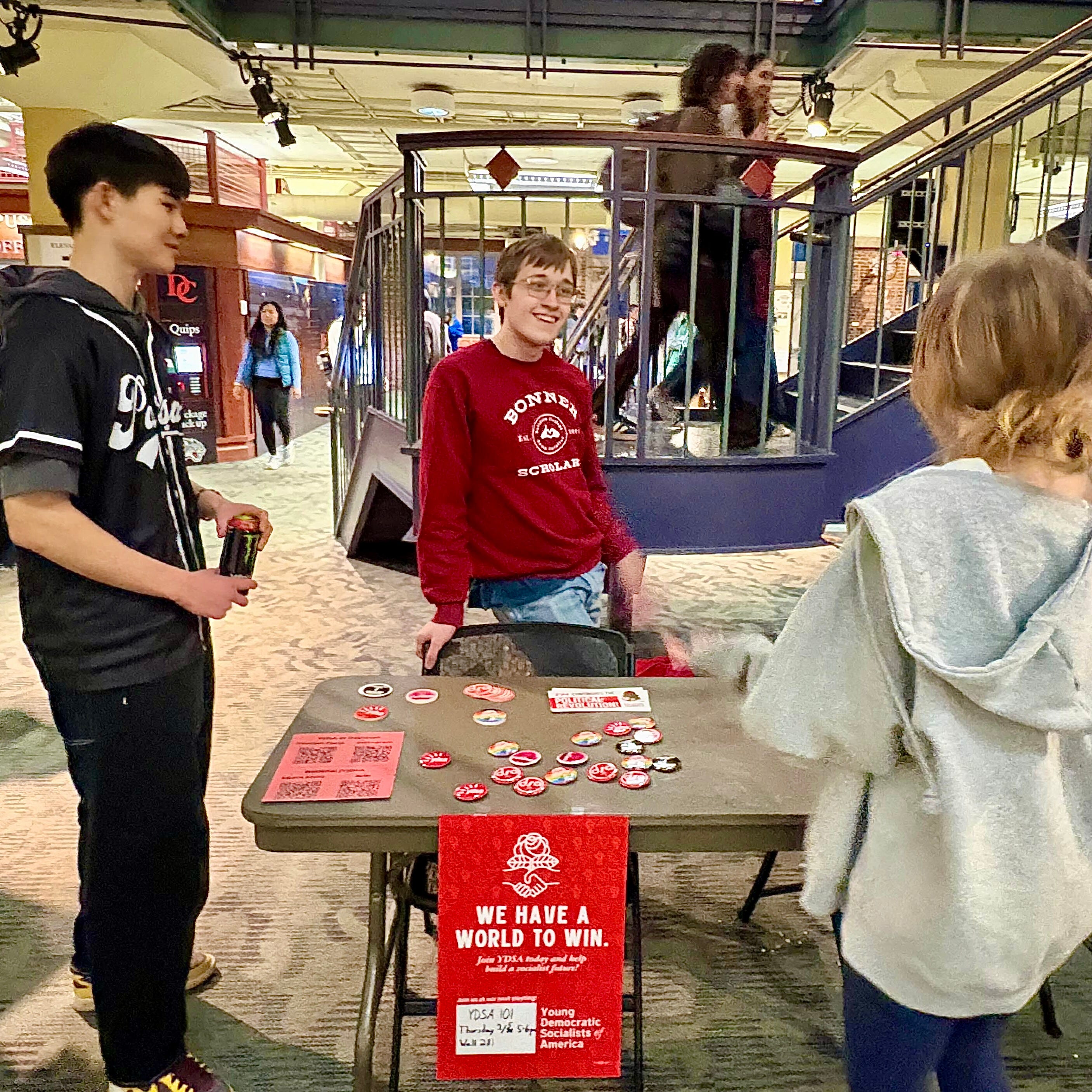
This fragmentation, however, is no longer confined to the political right. In recent weeks, it has been further compounded by the formation of the Davidson chapter of the Young Democratic Socialists of America (DC-YDSA). According to its constitution, the organization’s mission is to “articulate and defend the idea that true human liberation is impossible under capitalism.” In doing so, the DC-YDSA introduces a new ideological strand into a campus long dominated by the Democrats, Republicans, and Libertarians.
Following in the footsteps of TPUSA, the DC-YDSA neither aims to receive monetary funding from Davidson College nor wants to fall within the registration of the Center for Political Engagement (CPE), the entity that presently houses the Davidson Democrats, Republicans, and Libertarians. Instead, DC-YDSA will source its funding from the national organization.
For DC-YDSA president Carter Ratcliff ‘27, this decision stems from a desire for autonomy. “While the CPE does not govern political organizations on campus, we still wanted a greater degree of independence and separation from the college, especially given the current political climate,” Ratcliff said. “This protects both us and the college, and further opens the door for us to opportunities such as endorsing political candidates in the future.”
Ratcliff emphasized that alternate funding does not preclude the DC-YDSA from cooperating with other groups on campus. “The organization is premised upon three critical pillars: community-building, political education, and social service,” Ratcliff explained, pointing to a YDSA project in Charlotte that involved building benches at bus stops for people to rest as an example of the group’s approach.
“By maintaining consensus on certain foundational principles, we aim to work with other groups towards political aims and community well-being.” This sentiment echoes comments provided by other political organizations, such as the Davidson College Democrats, alongside non-partisan entities such as the CPE.
The spirit of cooperation, however, is tempered by political realities. Ratcliff notes that partnering with the DC-YDSA would be a considerably difficult proposition to consider for other groups due to its socialist nature. The issue is further compounded by the opinion provided by Alexa Cohen ‘27, President of the Davidson College Republicans: “I am not sure if cooperation would necessarily be possible owing to ideological differences; I am also uncertain if [DC-YDSA] would want to engage with any event we would be interested in hosting.”
She claims that the ideological gulf between the Republicans and the DC-YDSA, which she considers to be a far-left organization, would make cooperation very difficult. She further contrasts it with her group’s interactions with the Davidson College Democrats, claiming that they, despite different policy prescriptions, “have a lot in common.”
Cohen further suggested that Davidson’s political landscape may be fragmenting into what she described as a “Europe-styled multiparty political system”, in which multiple organizations occupy narrower ideological lanes. Even so, she argued that these entities are coalescing into broader political factions of “left” and “right” that operate on their own respective lines.
For the political left, Cohen speculated that any alliance-building between the Democrats and the DC-YDSA would be in response to the recent resurgence of conservative organizations such as Turning Point USA and Young Americans for Freedom. If this is the case, such polarisation risks undermining prospects for cross-group cooperation on campus, as political interactions will become more adversarial in nature and less focused on shared interests.
Yet even within these broader factions, ideological unity is far from guaranteed. That reality was made evident during Turning Point USA’s “Prove Me Wrong” event held last semester, where divisions within conservative student politics surfaced publicly. Among the students who challenged TPUSA president Oliver Genovese ’28 was Cohen herself, who debated him over legal immigration.
They disagreed on the restrictions of immigrants from what Cohen called “target” countries, with Cohen arguing that such restrictions were needed to prevent immigration from “populations that are extremely anti-western, anti-American.” Genovese disagreed on the restriction, stating that “people who come to the U.S. generally align with our ideals” and therefore we should “give people the chance to come to the U.S.”
The fact that these differences were unveiled at TPUSA’s “Prove Me Wrong” debate event in an argument between the organization’s leader and the president of the College Republicans shows that organized politics on our campus is fragmenting.
As for DC-YDSA’s interactions with organizations like TPUSA and YAF, it is natural to assume that these will be fraught with tension. Unlike the umbrella-like structure of the Democrats and the Republicans, which permits different ideological dispositions within the same organization and facilitates outside cooperation, the same cannot be said for these revisionist partisan groups, which hold directly opposite views of democratic socialism and limited government with free market capitalism. This polarization would pose a great impediment to collaboration at Davidson.
Even so, cooperation amongst these organizations is not impossible. Davidson’s partisan groups can navigate this polarized environment through mediators such as the Deliberative Citizenship Initiative, which has previously worked with political organizations on campus. Furthermore, it is important to account for the positions of individual leaders within these organizations.
Oliver Genovese ‘28, the President for TPUSA’s Davidson chapter, argues that collaboration on issues such as civic discourse can be made by all parties concerned, regardless of ideological affiliation. Reflecting upon his attempts to coordinate a debate event with the Davidson College Democrats ahead of the midterm elections, Genovese welcomes YDSA’s participation in the exercise, “I attempt to look beyond the political affiliation for the dignity of the human being….if the YDSA wants to participate, I would be more than happy to have them there. The more opinions there are, the better.”
If nothing else, perhaps the spirit of multipartisanship might be found in something as fundamental as community service, which is something Genovese thinks TPUSA can work with the YDSA on, provided any explicit socialist connotations are kept out of the event programming. “I mean, if it’s a community event [YDSA] wants to do, it’s good for the community, and it’s not something that’s purely socialist; that’s good for the community, I’m fine working with them.”
Despite ideological polarization on the national stage, Davidson today sees a more unique process of political fragmentation on its campus. Partisanship at this college stands at an evolutionary crossroads. As to the nature of what course it takes, that is something which the members and leaders of our institution’s partisan organizations will decide: the ball is firmly in their court.
