

Colleges generally expect their students not to plagiarize. Colleges expect their students not to do many things, ranging from vandalizing the campus to betting on the school’s sports games to invading other students’ privacy. These expectations that colleges place on their students are usually found in some sort of student code of conduct — Davidson’s are found in the Honor Code and Code of Responsibility, which are located together with the Code of Disciplinary Procedures in the Student Handbook. How ironic would it be then, for a school to plagiarize portions of its student handbook, the very document where it sets out how it expects students not to do the same?
What Is Plagiarism?
Merriam-Webster defines the term plagiarize as “to steal and pass off (the ideas or words of another) as one’s own” or to “use (another’s production) without crediting the source.” Davidson College defines it as “representing another’s ideas or words as one’s own.” And Lafayette College defines it as “[i]ncorporating someone else’s ideas, writings, or other intellectual products into your work without proper attribution.” I like all of these definitions. How much of someone else’s work is appropriate to take, and what proper attribution means will vary based on community, medium of expression, and circumstances. But regardless of the exact circumstances, one maxim shines through: if you take someone else’s words, you must credit them appropriately.
The Matter At Hand
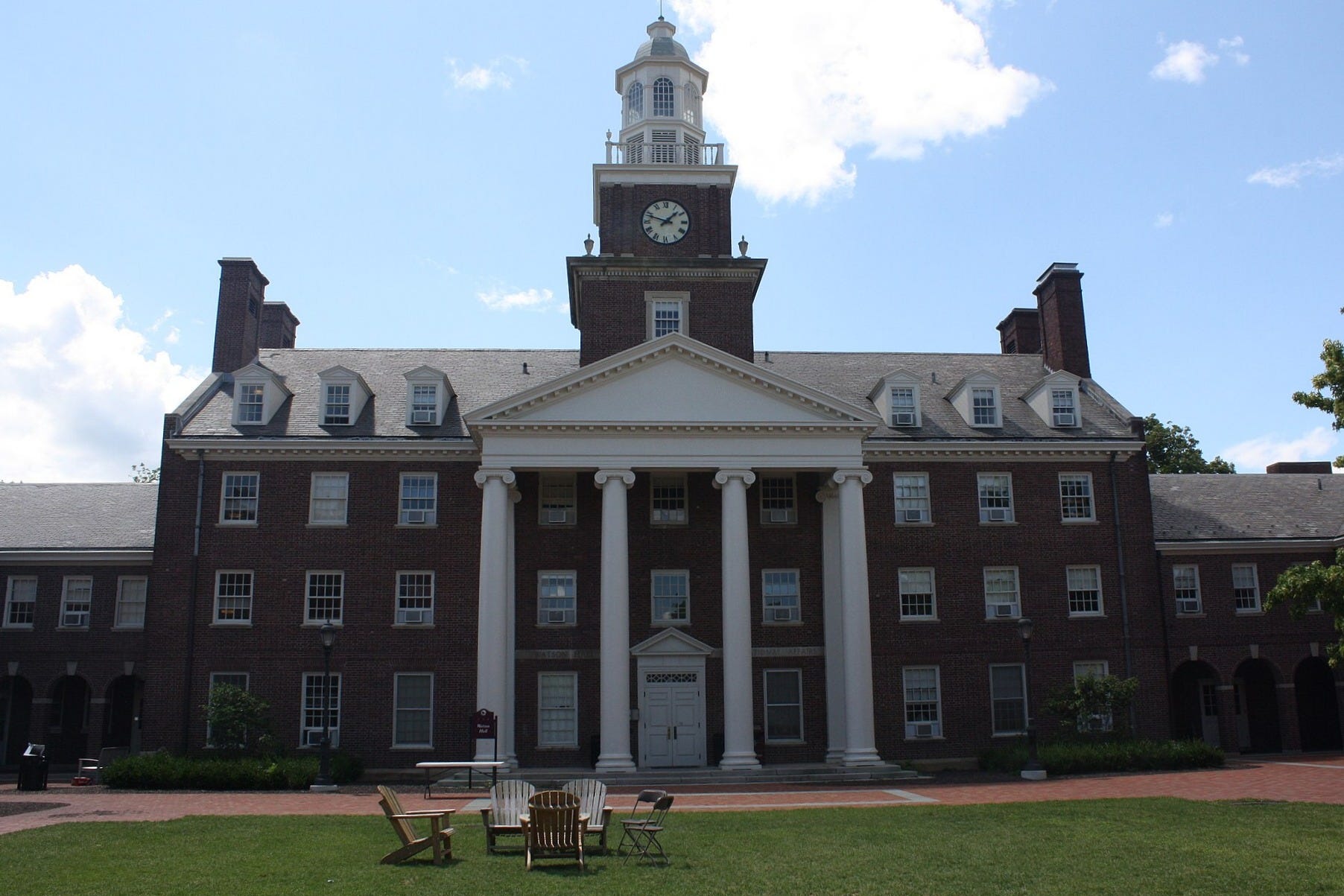
If you couldn’t tell based on this article’s cover photo (or the inclusion of their definition in the preceding section), this story is about Lafayette College. Lafayette is a small liberal arts college in Easton, Pennsylvania, founded in 1826 with around 2,700 undergraduates, according to its website. Lafayette also appears to have plagiarized from Davidson’s student handbook for its own.
Since student handbooks are not endeavors of academic scholarship, it is perfectly reasonable to expect that they will borrow language from each other, and that they won’t individually credit each time they do so. However, it is also perfectly reasonable to expect some form of credit, whatever the “proper attribution” for this medium is. To take Davidson’s Student Handbook as a guide, its first page credits ten other institutions, including the University of Tennessee at Chattanooga, from which it borrowed many definitions.
At the time of writing, Lafayette’s student handbook (the handbook as of September 14, 2026) does not credit any other institutions in any way. It does not even allude to having taken inspiration or language from any other source. And yet, by my count, it has taken at least 2,000 words from Davidson College alone. The copying appears to be confined to its third part, “The Conduct Process.” Not all of this is purely verbatim copying — Lafayette has typically adjusted certain Davidson terms to ones from its own lexicon. For example, many mentions of the “student accountability process” in Davidson materials are changed to discuss the “student conduct process” when transplanted into Lafayette materials. But make no mistake, this was not paraphrasing or adaptation of small phrases. This was widespread word for word copying. There are too many examples to list them all here, but I will provide one.
“Accountability plans are developmental tools that enable the College to respond to student’s documented misconduct in appropriate and restorative ways. They may be educational or disciplinary in nature.”
The above paragraph appears word for word in both the Lafayette and Davidson Student Handbooks. And based on my searching, it is not some stock phrase that every college uses. It appears only in those two places. To check this, I ran sentences or text fragments through Google in quotes. Even a simple fragment, “They may be educational or disciplinary in nature,” when searched, appears only in the Davidson and Lafayette Student Handbooks.
How Plagiarism Gets Caught
At this point, it would be fair to ask: “Zach, how on earth did you discover this?” I think the answer to that question can tell us a lot about how plagiarism in general gets caught.
On one Thursday afternoon in late August, I was engaging in the extremely normal activity of comparing student conduct codes. Specifically, I was curious how other institutions similar to Davidson handled their appeals processes. As I was thinking of schools to check, Lafayette came to mind. I remembered I had toured its campus around two years ago and it was a small liberal arts school slightly bigger than Davidson. I pulled up its student handbook, navigated to the section on process, and started to scroll down to the Appeals section. Before I got there however, I began to read through the “Rights and Responsibilities” section:
“Any student (a “Respondent”) alleged to have violated the Code of Responsibility subject to student conduct proceedings before the case administrator, conduct board, or hearing officer, will be afforded the following rights:”
“Huh, that sounds familiar,” I thought. As I continued to read, it kept sounding familiar. It then began to enter my mind: “Did Lafayette plagiarize part of the Code of Disciplinary Procedures?” Shortly thereafter, I was convinced that it did. I pulled up the Davidson handbook and verified the extreme similarity between the statements. But how could I be sure Lafayette had taken from Davidson and not the other way around? Later research would show that Lafayette seemingly adopted the first version of their handbook containing its plagiarism in the summer of 2025, and that much of the appropriated language appeared in a Davidson handbook from 2024. But I was confident even before I did this research, because of three words from the above paragraph: “Code of Responsibility.”
Sloppy Copying
A lot of the time, catching plagiarism requires someone with knowledge of the original source to read the copy and think: “Huh, that sounds familiar.” But on occasion, through sloppy copying, clues can be left that don’t require intimate knowledge of the source material to find. The sloppiness in this case was not quite as bad as a student leaving a line like “Sure! Here’s a 500-word human-sounding essay on this book.” in their hastily copied-and-pasted AI-written essay, but it still provides glaringly obvious evidence of the plagiarism.
Lafayette College, as it happens, does not have a Code of Responsibility. Now, Davidson is not the only school to call its conduct code by that name. Presbyterian College and UNC Asheville both use that phrasing, along with several secondary schools. Lafayette College however, does not fall into that company. When copying Davidson’s statement, Lafayette changed the discussed hearing bodies to its own and removed a reference to the Honor Code (how ironic), but failed to change “Code of Responsibility” to its institutional term: “Student Code of Conduct.” This Davidsonism appears thrice in Lafayette’s document. I fail to see any possible explanation for this other than Lafayette copying from Davidson.
The Path Forward
Lafayette could brush this under the rug, if desired. I doubt this story will plaster the front pages, and all things considered, this is not a very severe form of plagiarism. Like I said, these are not works of scholarship. There is nothing wrong with copying language for student handbooks; it is common and expected. I only see this as an issue because Lafayette failed to give credit.
And yet, this issue has great symbolic importance. Others have written in this publication about the precarious state Davidson’s Honor Code is in. That situation is not unique to Davidson. All across academia, integrity is imperiled like never before. Will Lafayette rise to the occasion? I hope it will, just as I hope and believe Davidson will.
A college can hardly expect its students to follow rules that it flouts itself.
In my view, Lafayette should properly credit Davidson and any other institutions it took language from. Ultimately, it is in the hands of the Lafayette community to decide how seriously it wants to take this, what the path forward is, what values it wants to have, and whether the school should be an exemplar of those values.
Lafayette College did not respond to a request for comment. Additionally, a Davidson College official speaking on-background confirmed that there was no coordination between the schools regarding the handbooks and that the school bears no ill-will towards Lafayette regarding this situation.