



My fingers sift through my cigarette-stained vinyls passed down from my uncle. Miles Davis’ Kind of Blue, Billy Joel’s 52nd Street, Stevie Wonder’s Songs in the Key of Life. The sleeves crackle beneath my hands like brittle paint. Behind me, my closet glows with vibrant pinks and yellows, the colors I imagine the 70s must have carried everywhere. My beat-down Boston Birkenstocks wait on the carpeted floor, curled leather and darkened cork. My twin bed sits beneath four fluffy pillows and a two-inch mattress topper that felt like heaven compared to the hard hostel bunks. Sunlight warms my corner room in Chidsey. For the first time in five weeks I was going to sleep in a room with fewer than twenty people.
Yet as I watched the sunlight climb my window I missed the cold rain of Ireland. I missed the heavy black backpack that carried my life for five weeks. Two sweatshirts. One Carhartt jacket. Two pairs of dark jeans. A rotating cast of shirts, socks, and underwear. I missed hostel kitchens that smelled of fish and damp metal, crowded with strangers waiting for boiling water. I missed walking thirty thousand steps a day and peeling off shoes from red blistered feet. Most of all I missed being alone thousands of miles from everyone I knew. I missed three hour friendships that lasted exactly as long as the city they were born in.
If my Dean Rusk project required a title it would be Death Practices in Ireland. I gathered enough interviews, photos, and notes to construct a research paper on funerary traditions, civic infrastructure, and the choreography of grief. Instead I stared at my vinyl copy of Pet Sounds. The sheep on the cover pulled my mind back to Ireland’s hills and seaside farms, and I began to imagine my time there as an assortment of albums.Each city and cemetery, each hostel kitchen and rain-soaked street, formed its own record with its own mood and tempo.
I sorted through my records and pulled one of Dublin. The cover felt cool and matte against my fingers, like the marble headstones at Glasnevin. An old Irish man led me through the cemetery as if he were related to every grave we passed. At the entrance lay the famine graves, hundreds of thousands buried in mass plots with few names and no ages. Farther in were the martyrs of the War of Independence, young men whose unfinished lives became part of the republic’s origin story. Finally we reached the newer burials, people who had died in old age, surrounded by families they had raised and outlived. The famine dead and the revolutionary dead were remembered for the lives they were denied. The elderly were honored for the full arcs they had been granted. In Ireland both were worth marking because both said something about the nation.
Rows of Irish yew bent over the paths like old men watching the living walk among the dead. I expected silence. Instead, children chased birds, traced names on headstones, and laughed as dogs sniffed the earth. It was the first place I saw death treated as both narrative and infrastructure, a story to be told and a system to be maintained.
The second side of the record was scratched dark and smelled of cold stone, dust, and iron. At Kilmainham Gaol we walked through the small chapel where Joseph Plunkett married Grace Gifford under the rifles of British soldiers an hour before his execution. His wedding ring barely had time to warm against his skin. The gaol held the leaders of the Easter Rising, men who had tried to wrench Ireland toward independence and were now waiting for death. Cobblestone walls narrowed the sky into a strip of pale light. A single cross marked the place where the firing squad stood. The bodies were buried without ceremony in a mass grave.
The British believed the executions would extinguish the rebellion, but they just created martyrs. Men once dismissed as fanatics became tragic heroes whose deaths authenticated the cause of Irish independence. Working part-time in a funeral home in the United States had taught me that death could be sanitized and private. Kilmainham taught me it could be disciplinary and nation-building. The state kills to control and the nation remembers to legitimize.
I sifted again and pulled the small damp record of Galway. It opened with the warm voice of a funeral director who in his free time acted in children’s musicals. He told me about wakes and the things people say about them, half reverent and half amused. “God, she looks better than the last time I saw her,” he said, mimicking an old woman peering into the coffin. At wakes people drink, tell stories, gossip, pray, laugh, and cry. Death is not quarantined from life. It spills into the kitchen and the parlor. In Galway life begins its afterlife among the living.
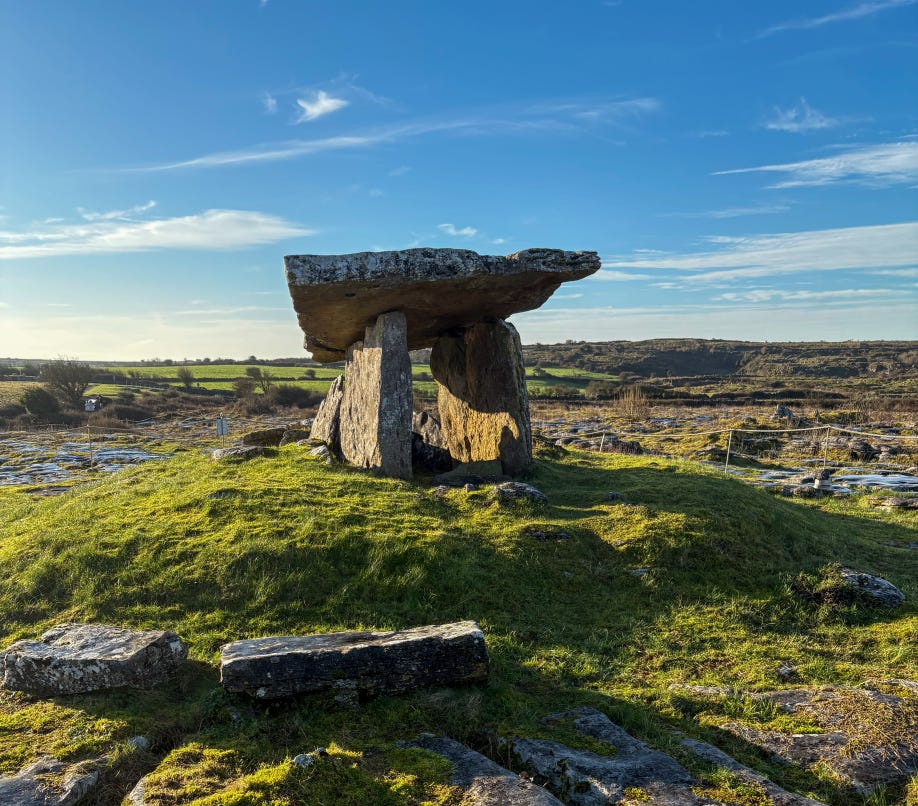
Outside the city the countryside held older forms of remembrance. At Poulnabrone and other portal tombs built roughly 5500 years ago, the dead were sent into the next world beneath slabs of limestone tilted like doorways. These tombs made death feel less like an ending and more like a passage. Wind hissed through the stones and sheep grazed around them as if history were simply another field to be eaten down. Time had not erased the dead there. It had folded them into the landscape.
I sifted again and pulled the industrial record of Cork. Its grooves smelled of rust and salt, a reminder that the city grew around its river and its prisons. At Spike Island the dead did not arrive all at once as they had in the famine graves. They arrived slowly, worn down by confinement and labor. The tour guide called it the Irish Alcatraz, but the comparison missed the point. Here time itself became the instrument of punishment. Inside the prison blocks the air was sour with iron and damp paper. Rows of cells lined the corridor like filing cabinets for unwanted bodies. Death here was administrative. Ledgers recorded inmates with neat columns of crimes, sentences, ages, illnesses, and deaths. Before a person could die, they had to be categorized. Before they could be remembered, they had to be processed.
Across the harbor in Cobh I found a different kind of death. It was the last place many Irish touched before emigrating. Families stood on the pier and watched sons and daughters disappear into the Atlantic, not knowing if they would ever return. Emigration became a kind of social death. The body survived, but the person was removed from the community. Letters arrived in place of faces. Names were spoken in the past tense. At home belongings were kept in drawers like relics. The living mourned without funerals, even as the emigrants built new lives abroad.
I sifted once more and pulled the Belfast record. Its surface was cracked with barbed grooves and printed in two colors, green and orange. Belfast was the first city where the dead did not simply rest. They took sides. We drove past murals of young men in balaclavas holding rifles, their faces once alive and now rendered in flat paint. In other places the martyrs wore suits and soft smiles, their portraits framed with lilies or Celtic knots. On one wall the words “Our revenge will be the laughter of our children” floated above a painted funeral procession. In Belfast the dead are drafted into the present. They do not leave the conflict. They continue it. We walked along the peace walls, massive slabs of concrete and steel that split neighborhoods into Catholic and Protestant like the spine of a broken book. Families pinned notes, photographs, and dates to the walls as if negotiating who the dead belonged to. Cemeteries, murals, parades, and plaques all claimed the dead as evidence for competing histories of suffering. A city once torn apart had become a public classroom where the dead were not simply mourned but interpreted.
Back in my quiet room in Chidsey I listened through the records and realized that death in Ireland was never merely an ending. It was a structure. It organized memory, community, politics, and even migration. The Irish dead did not disappear. They continued working. In Dublin they became a national narrative. In Galway, they remained in the house through wakes and rituals. In Cork they were processed by the state or lost across the sea. In Belfast they became martyrs and arguments.
What I learned is that a society’s treatment of death reveals what it values. If the dead are hidden, the living grieve alone. If the dead are shared, the living are held together. Ireland refuses to let the dead vanish. It keeps them in stories, walls, ledgers, graves, and songs. The result is that death becomes part of public life rather than its quiet opposite. Death must live in the public sphere because the worst thing that can happen to the living is to forget that they are going to die. When mortality disappears from view, life becomes shallow and private grief becomes heavier.
The broader lesson is simple. Death belongs to the living. We do not choose how we die, but we do choose how we remember. And those choices determine whether a society fractures or coheres. I slid the records back into their sleeves, realizing that none of them were really about dying at all. They were about how the living arrange what remains, turning silence into memory after the record’s last notes fade.