
Each year, the Chief Justice of the Supreme Court releases an end-of-year report on the federal judiciary. Formally, the report summarizes caseloads, staffing, and the operational health of the courts. Over time, however, it has also become a place for the Chief Justice to reflect on the broader meaning of the American legal system and address any current threats it may face.
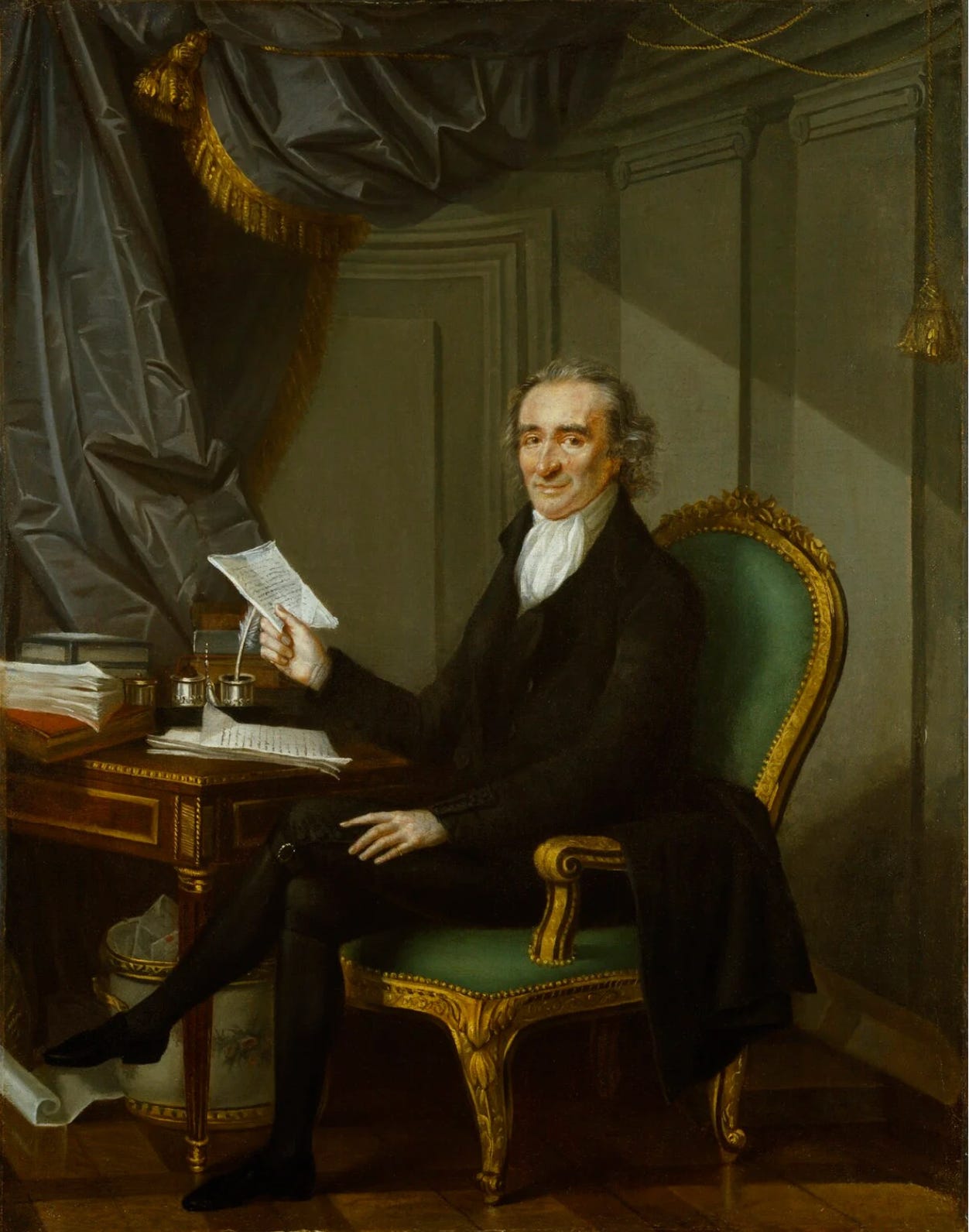
This year, Chief Justice John Roberts devoted the opening section of his report to Thomas Paine. This is a notable choice, considering one might expect a traditional justice to focus on the more familiar figures of the founding, such as Washington or Jefferson. Instead, Roberts tells the story of Paine, a struggling English immigrant who arrived in Philadelphia in 1774 nearly penniless, relied on a letter of recommendation from Benjamin Franklin, and soon became one of the most influential political writers in American history. Paine’s pamphlet Common Sense, Roberts notes, adopted plain, direct language in place of legal jargon, effectively democratizing political argument and advancing the idea that government exists to serve the people rather than rule them.
Unlike founders like Madison, Paine was not a cautious constitutional designer or a member of the colonial elite. Rather, he was something of a political radical in his belief in the natural rights of every human and in his outspoken criticism of monarchy and slavery. By foregrounding Paine rather than more conventional founders, Roberts is offering a particularly deliberate interpretation of what the American project was meant to be.
That interpretation arrives at a moment when the meaning of the founding is increasingly contested. On the ideological left, the 1619 Project frames the Declaration of Independence as a document designed primarily to protect slavery and white supremacy. On the right, a growing movement argues that the founding was flawed because it prioritized individual rights over moral authority, religion, and social cohesion. Both perspectives, in different ways, reject the founding as morally authoritative, instead turning toward alternative frameworks grounded in class and racial structure or in classical notions of virtue and the “good society.”
Roberts does not address either camp directly. Instead, he builds a different story around Paine and the Declaration of Independence. Roberts, notably, remarks that the American mantra of unbridled individual freedom present in the Declaration was more aspirational than descriptive, given that a substantial number of its signers participated in the system of slavery. Yet the importance of the Declaration, as Roberts insists, is that it articulated an ideal that could be invoked by later generations even when it was not yet enforced.
To make that point, he draws heavily on Abraham Lincoln’s interpretation of the Declaration. Lincoln argued that the phrase “all men are created equal” was written not because it was already true, but so that it could serve as a standard against which future laws and institutions could be judged. In that sense, the Declaration functioned less as a description of the country as it existed and more as a statement of an ideal to be reached.
Here, Roberts’s account takes a turn that is often associated more with liberal constitutional thought than with conservative jurisprudence. He traces a line from the Declaration to Frederick Douglass, Susan B. Anthony, Martin Luther King Jr., and even Justice John Marshall Harlan’s dissent in Plessy v. Ferguson. Each, in different ways, appealed to the Declaration’s promise of equality to challenge laws and institutions that denied it. Rather than treating these figures as critics of the founding, Roberts presents them as participants in its unfinished project.
Just as important as what Roberts includes, however, is what he leaves out. His account contains little of what has defined conservative legal rhetoric for much of the past century. There is no emphasis on gun rights, limited government, or originalist constraint, and no defense of tradition for its own sake. Instead, the report closes with a call for all three branches of government to work together, across time, to bring American law into closer alignment with the principles of the Declaration.
That framing is especially striking at a moment when both Congress and the Supreme Court have been criticized for failing to serve as meaningful checks on the executive branch. Roberts’s insistence on institutional balance and shared responsibility reads less like a neutral historical reflection and more like a quiet reminder of what constitutional government is meant to be.
In a year marking the 250th anniversary of the American founding, Roberts’s report offers a sobering counterpoint to the Trump administration’s plans to host a UFC event on the White House lawn on June 14, partly to commemorate the founding and partly to celebrate the president’s own birthday. Increasingly, anniversaries of this magnitude are defined by celebration-driven spectacle rather than reflection. This exclusive focus on pageantry leaves little room to ask what it actually means to be an American, or what the founders were trying to create. That is what makes Roberts’s focus on the rebels of the American story so striking. Appointed by George W. Bush, who once described him as a man of decency and a kind heart, Roberts now seems either uniquely well-suited to this moment or unexpectedly shaped by it.
Thomas Paine, in this telling, is a symbol not just of the founding but of America’s pathway of hope and opportunity. He arrived poor, made his way into public life, and helped give a restless collection of colonies a political identity. Roberts’s report uses Paine to make the claim that the United States was not founded as a closed ethnic or religious community, nor as a finished moral order, but as an argument that human beings are born with rights and that governments exist to secure them. Two hundred and fifty years later, that argument remains unresolved.