


The first test Professor Pete Benbow gave back this semester confused his students. A few saw low scores and asked how they had done so poorly. The thing is, they didn’t. “It doesn’t mean anything,” Benbow reassured them. In his databases course, points no longer count in a traditional way toward the course grade. The question is whether a student met a standard or not.
This exposes a broader question facing higher education: What should a grade actually measure? As universities confront grade inflation, preparedness, and the value of a transcript in post-graduate outcomes, Davidson College is leaving that question to the professors themselves to answer. Without department-wide or institutional grading standards, faculty have full autonomy to decide how students earn their grades, ultimately resulting in a campus where students have differing definitions of academic success.
Across the country, grades and their meaning are being highly debated. Harvard, the university largely at the center of the discourse, released a report last October indicating that 60 percent of the grades given in 2025 were A’s. In May, faculty members voted to cap A’s at 20 percent of each course, and in August, Secretary of Education Linda McMahon called on universities to publish plans to combat grade inflation. Davidson is part of the trend too: the median GPA for the class of 2026 was 3.711, or an A- average. For the first time since at least 2020, that number did not rise from the previous year; in fact, it fell by 0.04 points.
At Davidson College, how a course is graded is entirely up to the professor teaching it. The latitude that comes with that autonomy lends itself to a variety of different approaches, from a writing class with no grades on essays to a data science course where numerical points on exams do not count toward a final grade, at least not in a traditional sense.
“Grading is a matter of the professor’s professional judgment.” Dr. Shelley Rigger, Vice President for Academic Affairs and Dean of Faculty, wrote to Lux. “We respect faculty autonomy and authority when it comes to grading, including the individual grades they assign and the practices they use.” The college tracks neither a professor’s individual grading method, nor the prevalence of traditional versus nontraditional approaches as a whole. “Davidson faculty are constantly trying new pedagogical strategies,” Rigger wrote. “I suspect the number [of faculty experimenting with alternative grading methods] changes constantly.”
Rigger wrote that the Education Policy Committee at Davidson has discussed alternative grading, grade inflation, and pass/fail, “many times.” Those conversations usually “start with an observation, but they quickly become philosophical, because the question of what grading is for is a deeply philosophical one.”
Four professors were consulted about these alternative styles, and each took a different approach. However, a common theme was present in all: the desire to give students the greatest chance of success. That sentiment was expressed in ungrading, labor-based contract grading, self-assessment with flexible revision, and standards-based grading styles.
Ungrading: “providing ways for them to succeed”
Dr. Rick Gay, an educational studies professor who has taught since 1976 and came to Davidson in 1999, traces modern grading to the late 19th century, when schools adopted an “industrial model built to sort people.” In his view, grades still do so. He recalled a student who worried that a single B would decide whether he would be able to go to law school or not.
He changed his approach during COVID. While many teachers quit the profession altogether, the pandemic energized Gay. Davidson ran seminars to help faculty adjust to the new learning environment and one of these seminars introduced the concept of universal design, or building a course so that accommodations for individuals are not required, so that anyone can take it.
As in his other classes, Dr. Gay does not give grades on papers in his first-year writing course. Simply, when a paper comes in that is not satisfactory, he returns it to the student to be redone. His emphasis here is that when students see a grade on the top of a returned paper, they do not look at comments. This way, the students read through the feedback given throughout the assignment, and as a result gain a far better understanding of their grasp of the content of the class and their standing in it. While completion still counts as part of their overall course grade, a student who skips assignments cannot pass, and one who turns in two-thirds of the work will not earn an A.
For those who have had Dr. Gay in class, it’s evident that he does not care very much for AI provisions. He says this grading approach adds to that and has freed him from “policing AI.” After decades of teaching, he said he can tell when a student has had “too much help.”
In all, Dr. Gay says there have been three large changes since he dropped grades: students rarely miss class, they are more responsive during discussion, and the quality of written work he receives has improved. “My thing is to provide ways for them to succeed. That’s my mantra now,” Gay said. “If I can succeed without having given grades, that’s fine.”
Yet, Dr. Gay reminds us that there are always going to be trends in education, and that this, more likely than not, is another one of them.
Labor-based Contract Grading
Professor Maddie Norris, who teaches creative nonfiction, uses labor-based contract grading. Students who meet the baseline requirements, such as attending class, turning in work on time, and submitting revisions, automatically earn a B. To earn an A, they do additional work, such as another essay. This model comes from writing scholars Peter Elbow and Jane Danielewicz, whose version reintroduces quality judgments for grades over a B. Norris has removed that step, following scholar Asao Inoue. “I don’t really think there is objectivity in terms of writing,” she said. “I am one human being who has preferences.”
She switched to this grading method as a graduate instructor at the University of Arizona, where she found it hard to grade students from different educational backgrounds fairly. She explained that not everyone comes into an English class with the same level of writing experience, and that to grade them all on one rubric cannot result in a fair opportunity for success for all students.
She also sees the method as anti-racist. “When you are thinking about ‘how do I create an environment that allows those who are more marginalized to succeed,’ it allows for everyone to succeed,” she said.
The biggest change she sees as a result of this transition is in risk-taking. Davidson students often “write to the teacher.” Under a contract such as hers, they explore because the content of the writing contributes less to the grade. She’s also reported a higher number of major converts into English after taking her class simply for the Literary Thought Requirement.
“When you’re not worried about the grade, then you can actually enjoy the process,” Norris said.
Self-assessment and Revision
Professor Conner VanderBeek, an ethnomusicologist, keeps traditional letter grades but builds in self-assessment and flexible revision, mostly in introductory courses with many non-majors who bring in differing levels of experience in the field. They want students to “trust their own opinions and gut reactions” as a tool for analysis.
Dr. VanderBeek’s grading style does not ask about effort or how a student thinks they did, unlike Professor Norris’. They have set up assignments with differing requirements that all inherently allow for self-assessment of course understanding. One of their music theory essays asks the student to reflect on what worked in their processes and which parts connected with prior knowledge. Another world music essay asks students to name their favorite musical style and intellectual tool for engaging with music.
VanderBeek does not give exams, which “never really felt like they fit my learning objectives,” they said. Their courses use small assignments with a flexible extension policy, and weak work can be resubmitted for up to 80 percent credit, but few students need to. The goal is trust: students should feel they can ask for more time instead of turning in rushed work or work written with AI.
Standards
Alternative grades are not limited to the humanities. This semester, Pete Benbow switched his databases course from a 100-point scale, which he called “a very arbitrary method,” to a hybrid of standards-based and specifications grading. On a traditional test, he said, a question is worth a set number of points that a professor assigns, and a partial answer might earn half credit. The total that comes from that blends what a student knows with what they do not.
Those test points no longer matter in his course. “What matters is the simple binary truth, yes or no, did the student meet the standard?” he said. The course has four domains, each worth 15 percent and split into three tiers:
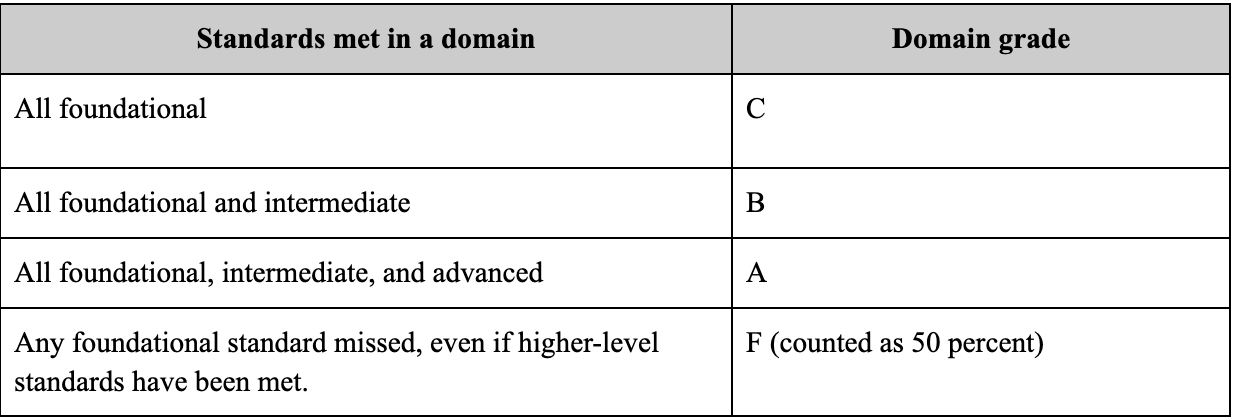
In one respect, this system is stricter than the traditional points scale. A student who misses one foundational standard fails that domain, no matter how well they do on advanced material. This is obfuscated in a traditional average.
Professor Benbow gives students the entire semester to prove mastery of all the domains, though. When, in the first exam, a student fails a domain, it will show up on each subsequent exam until the entire class has passed it, at which time it will be dropped from future exams. Due to this highly individualized system, Benbow gives each student a progress report that tells them what standards they have met. This way, a student can bring their printed report to an exam and may skip questions for which a standard they have mastered is being examined.
“With the traditional grading approach, you get one shot,” Benbow said. He emphasized that everyone has bad days and with his approach, a student doesn’t sink their grade off of one bad day or bad test. Simply, it makes it fairer. He adapted Linda Nilson’s book Specifications Grading and credits computer science professors Dr. Nemitz and Dr. Mark Barsoum for the idea.
Yet this system means more work and faster grading schedules for him. He has no student feedback yet, but he said this class understands the material better than his previous two and that he will continue to use this grading style.
Why Davidson?
Each professor gave a different account of what it is about Davidson that makes these methods work.
Conner VanderBeek said their approach would be “a difficult model to scale if I had more than 50 students in a semester.” At institutions like state universities where professors teach a higher number of classes and far more students per class than Davidson’s average class size of 16, it would be much harder. Davidson’s faculty-student ratio and teaching culture make it sustainable, they said.
For Benbow, Davidson students “tend toward perfectionism.” Traditional numerical grades that arbitrate success into percentages add to the pressure they already put on themselves. Built-in retakes and opportunities for revision mitigate it and teach that “failure is okay…failure is to be expected.”
While the current state of the Honor Code at Davidson is a common topic of debate and discussion on campus, Dr. Rigger said, “I think the Honor Code probably makes those methods work better, because it helps to cultivate honesty and integrity in students.”
Faculty culture is also a large factor in the prevalence of alternative grading styles. Professors have particularly close relationships at Davidson, comparing teaching and assessment styles often. Benbow attributed his adopting of standards-based assessment to other professors in STEM fields here at Davidson. English professor Andrew Rippeon began using fellow professor Norris’ labor-based contract grading system just this semester after hearing of her experience with the approach as well. Davidson’s unique environment is one in which innovative teaching and learning practices can be shared and adapted across disciplines.
Tradeoffs
The benefits professors describe, however, are largely based on their own observations rather than systematic evidence. Professor VanderBeek was more cautious about commenting on student work quality, and although they reported improved quality of submissions over the semester, they declined to credit it to the grading policy alone. Additionally, a professor who sees worse results from a change in grading style would likely switch back to traditional grades, and the college does not collect data that would settle the question of how many professors have done so.
Grade inflation is the clearest concern. Gay did acknowledge that under his system almost everyone gets an A. Under Norris’ contract, completing the baseline work guarantees a B. Norris said she is not concerned about inflation, though she said other professors have fair reasons to be.
Rigger also wrote that standards-based grading can build “a firmer foundation” when students must master one concept before the next, but that it “is a lot of work, and it doesn’t always make enough of a difference to justify the effort.”
Beyond the classroom, the effects of changing grading standards are also being felt. In a 2025 survey of 800 HR leaders by Hult International Business School, nearly 9 in 10 companies actively avoid hiring recent graduates. Of the companies that did hire recent grads in the previous year, 8 in 10 said they had fired some of them. Graduate schools and employers still use transcripts and grade point averages to determine student quality and potential. When a B or an A can represent two very different expectations depending on the course, transcripts become a less consistent measure of what a student actually knows and what they are capable of.
Asked how Davidson accounts for grades that mean different things in different courses, Rigger wrote that those institutions “don’t share with us how they use transcripts.”
Examining the default
The professors agreed on one point: the method matters less than the reason behind it. “It’s important to... critically examine why you’re using it,” Norris said.
For now, that choice stays with each professor. Norris expects the mix on campus to keep shifting. “Some people will adopt, and others are uninterested in doing so,” she said. At Davidson, both are allowed.