



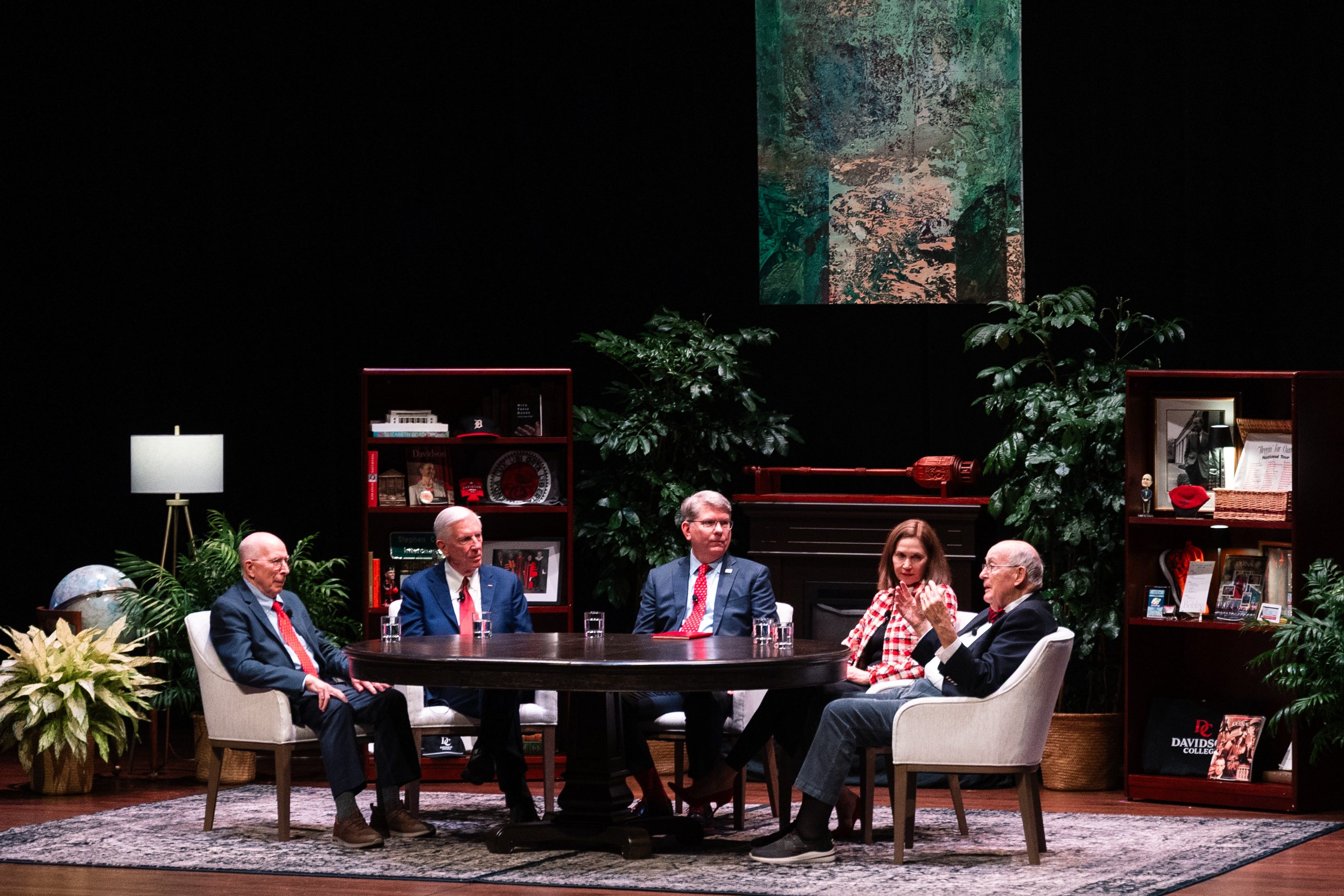
Davidson College will feature a congressman with a history of racist and sexist comments in an upcoming panel hosted by the Martin Institute for Public Good. Although technically protected by Davidson’s free speech provisions, inviting the congressman undermines the college’s core values and calls into question its commitment to humane instincts and the dignity of all people.
Representative Greg Murphy ’85 (R-NC-3) is slated to headline a moderated discussion on medical ethics and N.C. healthcare on November 13. Murphy, who served as Davidson’s Alumni President and was on the Board of Trustees from 2015-2017, is the only practicing surgeon in Congress and its only Davidson graduate. He also helped found Davidsonians for Freedom of Thought and Discourse in 2018 in response to what he called the “destruction” of free expression on campus.
One would hope Davidson could welcome Murphy with open arms. Hastily deleted tweets targeting former Vice President Kamala Harris and Representative Ilhan Omar, however, render a warm welcome inappropriate.
In October 2020, Murphy wrote on X, formerly known as Twitter, “@KamalaHarris is a walking disaster…she was only picked for her color and her race…is that how we pick our leaders now in America??” Murphy later clarified he meant to say “color and gender.”
In April 2021, Murphy responded to Congresswoman Ilhan Omar (D-MN), who is Muslim, after she tweeted her condolences for a Capitol Police officer killed when a driver rammed into a barricade outside the Capitol, adding, “The death toll would have been worse if the assailant had an AR-15 instead of a knife.” Murphy replied: “Would have been worse @Ilhan if they had been flying planes into the buildings also.”
Murphy does not appear to have publicly apologized for either tweet.
In June 2022, Murphy tweeted, “No one forces anyone to have sex,” just days after the U.S. Supreme Court overturned Roe v. Wade and ended federal abortion protections. Murphy deleted his tweet seemingly dismissing rape two hours later and backtracked in a statement to WITN, claiming he does not use the term “sex” to refer to nonconsensual intercourse.
More recently, Murphy has taken to criticizing the progressive wing of the Democratic Party. In July 2026, he tweeted, “The AntiAmerican Activists @AOC &@RoKhanna wish to destroy the American way of life with Socialism. Don’t be fooled. They wish to create a dictatorship and Politburo, like in all other Socialist regimes, that controls everything.”
Davidson has repeatedly recognized Murphy in Facebook posts and website features (1, 2, 3). Following Murphy’s tweet about Harris, 636 alumni signed a petition calling for the college to renounce his racism and to “stop celebrating and giving space” to him.
Recent forays into bad-faith outrage politics meant to stoke fear of the other side are almost a welcome departure from displays of racism, sexism and rape denial. Murphy’s appalling tweets are unbecoming of a congressman, let alone a Davidson graduate. Unfortunately for those who are upset by them, Davidson’s hands appear to be tied.
Criticizing Murphy could violate federal law and disinviting him could violate college policy. We must ask, then, whether the fact that the college can invite someone to speak means it should be free from reproach when it does—and whether an invitation can amount to an ethical failure.
In response to the 2020 petition, Davidson spokesman Mark Johnson explained to the Charlotte Observer that federal law prohibits the college “from doing anything that could be construed as advocacy for or against a candidate for elected office.” Even in off years, 501(c)(3) nonprofits are subject to strict regulations limiting political speech. Importantly, federal law does not require Davidson to invite Murphy as a headlining panelist.
Inviting a candidate to campus is not necessarily disallowed, either. Scheduling the event 10 days after the 2026 General Election on November 3 allows the college adequate time to advertise without violating prohibitions against endorsement.
Critically, rescinding an invitation is substantively different from renouncing an individual. If inviting Murphy to speak does not imply endorsement, then there must be a way to reverse course without implying condemnation. To be safe, Davidson could wait to do so until after the election. As it stands, though, disinviting Murphy would contravene college policy.
Davidson’s Commitment to Freedom of Expression, adopted in March 2023, grants little recourse when controversial speakers are invited. The document guarantees college community members “the broadest possible latitude” to speak and write their minds. Davidson may constrain expression if it “violates the law, falsely defames a specific individual, constitutes a genuine threat or harassment, unjustifiably invades substantial privacy or confidentiality interests or is otherwise directly incompatible with the functioning of the College.”
Calling Kamala Harris a diversity pick and invoking 9/11 to attack a Muslim congresswoman evidently falls short of Davidson’s regulatory threshold. It does, however, run afoul the Statement of Purpose, Davidson’s foundational document that ought to take precedence over (and inform interpretation of) its free speech policy.
Two days after the 2020 vice presidential debate, Davidson’s Office of Alumni and Family Engagement tweeted, “Davidson College seeks to develop in our students humane instincts and disciplined and creative minds. We value the exchange of ideas through respectful and civil discourse, free of epithets and racist or derogatory comments.”
The first sentence invokes Davidson’s Statement of Purpose. The college’s primary purpose is “to assist students in developing humane instincts and disciplined and creative minds for lives of leadership and service,” which includes “recognizing the dignity and worth of every person.”
The second sentence indicates that in 2020, Davidson valued “the exchange of ideas” insofar as it is free of “racist or derogatory comments.” The college’s commitment to civil discourse was tempered by considerations of humanity and dignity. Derogatory speech was seen as a violation of institutional values. Murphy’s remarks are therefore a direct repudiation of the values Davidson asks its graduates to carry.
The same judgment does not appear to apply under Davidson’s free expression statement. The question we should ask ourselves, then, is not whether Murphy’s tweets violate college policy, but whether Davidson should elevate Murphy as a representative of the institution.
Although inviting someone to speak is not an endorsement of character in the same way that hiring them would be, the calculation changes considering Murphy is an alum and beneficiary of positive PR. Alumni ought to be held to a higher standard—especially at institutions ostensibly concerned with character development. Moreover, repeated platforming is an unambiguous signal of institutional support. Taken together, it would be disingenuous to argue Davidson’s decisions to give space to Murphy cannot be construed as an endorsement of his character.
Davidson’s Statement of Purpose concludes: “To it much has been entrusted, and of it much is required.” Among those requirements is an ethical imperative to scrutinize the character of those invited to represent the college, whether as an event panelist or a recipient of positive press.
Racism, sexism and rape denial stand in direct opposition to Davidson’s values. Murphy’s statements are as disgraceful today as they were five years ago. In his own words, in a 2019 interview on the Davidson website: “Attacking somebody personally is never tolerable. Never.”
Davidson ought to rescind its invitation to Murphy and reflect upon the weight of its duty—rooted in the Reformed Tradition, amplified by the college’s dark history of racial injustice and uniquely relevant in today’s political climate—to uphold the dignity of all people and set a high bar for the conduct expected of its graduates. Making clear that Davidson will not settle for panelists who fail to apologize for racist and sexist comments is a good place to start.