


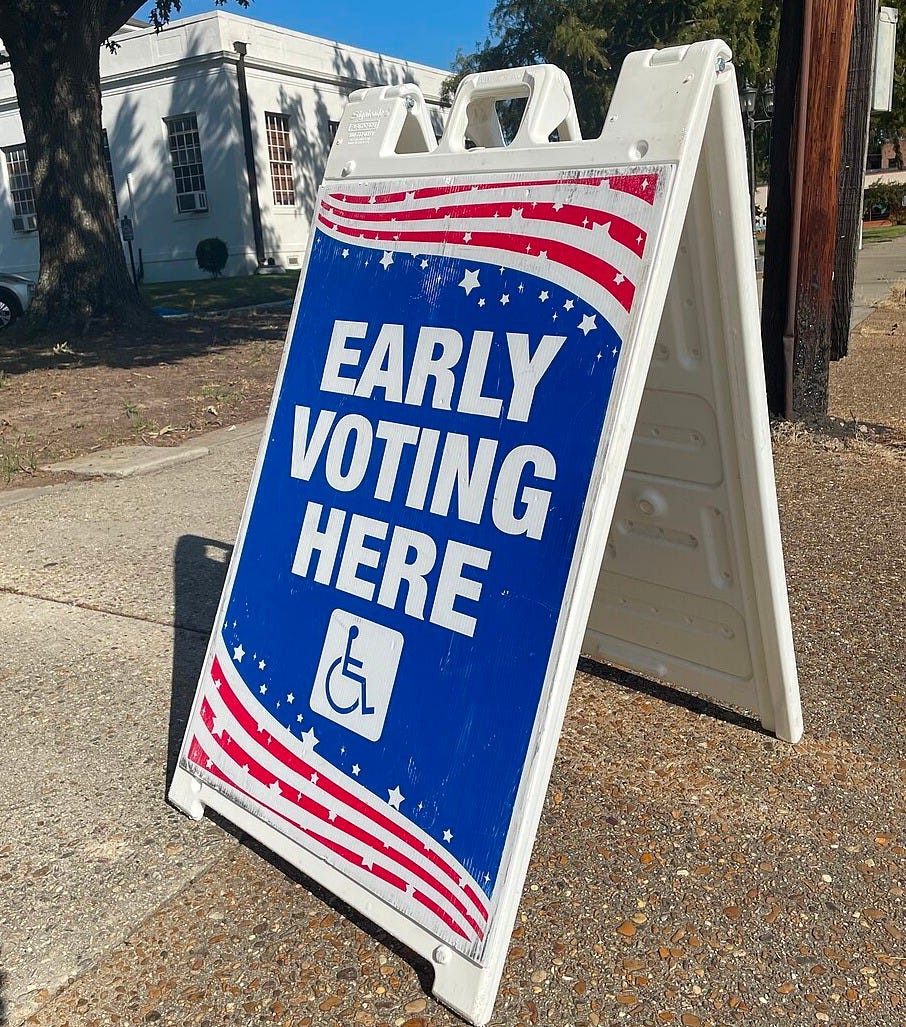
While most students were away from campus on summer break, their polling place was quietly removed as part of a concerted effort to suppress student participation in the upcoming 2026 midterm elections. Davidson is just one on a list of North Carolina schools facing similar treatment.
Just a half mile walk away, across campus and down Main Street, the Davidson Town Hall has served as a convenient voting site for as long as almost all students have been here. Though it remains available on Election Day, November 3rd, the closest early voting site for Davidson residents and students will be Cornelius Town Hall, entailing an unpleasant forty-five-minute walk down Main Street.
But it’s not just Davidson students: according to the College Democrats of North Carolina (CDNC), 21 of the 30 NC colleges and universities they track have early voting sites a mile or more away, with 13 of those being over 1.5 miles away, a distance which CDNC president Beck Whitehead described as simply an “unrealistic” walk for most. These include some of NC’s largest schools such as NC State, UNC Charlotte, and NC A&T, the nation’s largest historically black university.
Whitehead, an NC State student, describes his school’s voting site transition: “To see it get moved from our student union really to anywhere farther away is really upsetting [...] [I walked] to the new site to see how far it was, and it was about a 20-to-30-minute walk across a four-lane major highway.” He stressed that the old site garnered a campus culture of voting participation and that the new site would likely deter many student-voters.
Student action has not been fruitless, however, in fighting this suppression. Preceding the primary elections earlier this year, the Jackson County Board of Elections removed Western Carolina University’s early voting site. What remained was a 1.5-mile walk down a four-lane highway with no sidewalks or guardrails, and a site which according to WCU student and voting advocate Seth Digh, had “very limited parking” and couldn’t “handle the number of anticipated voters.”
Digh and other advocates raised awareness through social media posts and by organizing a march to the polls on February 13th. The march, including over eighty community members, showcased the dangerous walk and the ineffectiveness of the new voting site.
This past July, NC Local uncovered texts of Dallas Woodward, former Executive Director of the North Carolina Republican Party, texting the Jackson County Board of Elections (JCBOE) chair, “Don’t let them have a vote,” referring to WCU students. At the time, Woodward worked for Republican State Auditor Dave Boliek, who was given power in 2024 to control election boards in the state by NC’s Republican-controlled legislature.
What started as a more liberal movement in the form of the poll march turned into a bipartisan student initiative over the summer to restore voting access to WCU for the general election, with both partisan campus organizations issuing a joint statement to the State Board of Elections. With the help of Republican JCBOE member Jay Pavey, who broke with his party, WCU was given a new site which Digh described as “a compromise that I’m totally fine with.”
Whitehead commended Digh and WCU’s students: “It was much more openly bipartisan. And I think that’s why they got a voting site back. [...] They did a better job of being vocal, being visible, and being bipartisan. And that’s definitely a lesson [the CDNC] can learn.”
Early voting is convenient for the college student’s busy schedule, and, unlike normal Election Day, allows same-day voter registration. This means that it’s easier to vote for the first time, as many college students do, and that any problem with an existing registration can be solved by quickly re-registering. Without convenient early voting sites, many simply don’t bother, and those who do must choose between traveling further or risking their votes’ security.
As Davidson moves into early voting next month, campus political organizations and students should be careful to stay informed, plan ahead, and help each other get registered and get transportation. As Digh stated in a recent speech at a voters’ rally in Raleigh, “We will not walk on the side of the highway alone.”