


Imagine waking up every morning to find your tab from the day before:
“Yesterday, you spent 3 hours on your phone.”
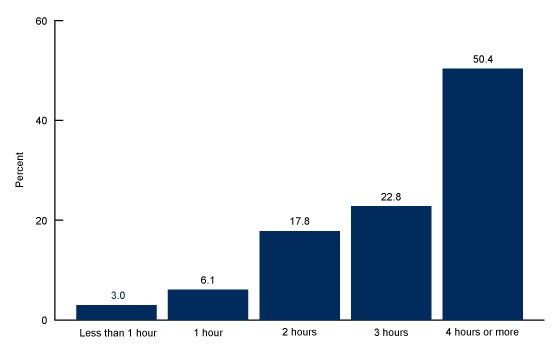
Harmless enough, right? But keep that up for a year, and you have just spent a month and a half of your life aimlessly scrolling. Stretch that to age 75, and that’s over 9 years of your life, surrendered to algorithms designed to steal your attention. In reality, 3 hours is on the short end of the spectrum. According to a 2023 Gallup poll, teenagers spend an average of 4.8 hours a day on social media apps, with total screen-time likely being much higher.
This digital addiction is common because we are constantly exposed to short-form content. Online, people have a simpler word for it: “brainrot.” Every time you open Instagram, TikTok, or any other highly dopaminergic app, you could be conditioning your brain to expect quick, intense bursts of rewards. If time on these apps is prolonged and becomes a habit, this can make studying, working, or focusing on mundane tasks feel less engaging by comparison. In addition, dopamine, which is our brain’s reward chemical, fluctuates throughout the day, so making a habit out of scrolling first thing in the morning trains your brain to crave that same pace for the rest of the day. As a result, slower, effortful tasks can feel disproportionately difficult after waking up and immediately checking your phone.
Percent distribution of teenagers ages 12–17, by hours of daily screen time: United States, July 2021–December 2023
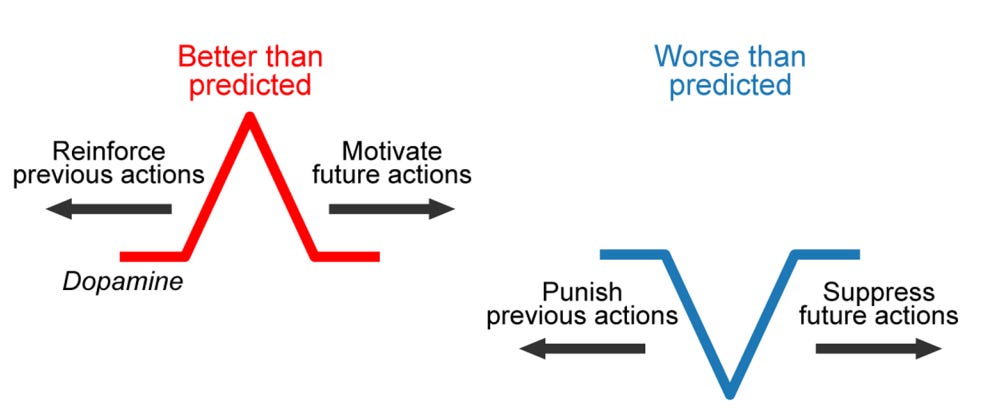
Another problem with these dopaminergic apps is that they are built around variable rewards: unpredictable scrolling and algorithms that track your watch time, likes, saves, and shares. Wolfram Schultz, a neuroscientist at the University of Cambridge, found that dopamine neurons fire strongest not for the reward itself, but for the surprise of getting more than you anticipated. Once a stimulus becomes predictable, the response fades out entirely. So, the possibility that the next swipe might deliver something better than the last is what keeps you pulled in, and what could turn a harmless 30-minute scroll into your whole afternoon gone.
What Endless Scrolling Does to Your Brain
Aside from the mental health issues, doom scrolling can have multiple effects on your brain. A systematic review and meta-analytic investigation of over 98,000 participants conducted by psychologists at Griffith University found that engagement with short-form videos, like the ones present in TikTok and Instagram is consistently associated with poorer cognitive performance, with the strongest hits landing on attention and inhibitory control—which is your brain’s ability to suppress impulsive behavior. Memory and language also showed much weaker associations, while reasoning abilities weren’t significantly affected at all. The researchers suggest this is driven by two processes: habituation, where your brain becomes desensitized to slower tasks like reading, and sensitization, where constant dopamine rewards condition your brain to crave instant stimulation. Interestingly, these effects were consistent across both young and adult users, meaning your brain’s reward and attention systems don’t have a significant impact on the brain developmental stage.
Furthermore, the same study found that short-form video use is also linked to poorer mental health, with stress and anxiety showing the strongest correlations, and weaker but still notable associations with depression, loneliness, and sleep quality.
How to Break the Cycle
If you find yourself tied to your screen or facing some side effects from this scroll-induced “brain rot,” the good news is that you can fix it. According to Bruce Goldman, a science writer at Stanford Medical School, all you need is a timeout. Goldman states a month is “typically the minimum amount of time we need away from our drug of choice, whether it’s heroin or Instagram, to reset our dopamine reward pathways.”
Deleting the app, setting time limits, or having someone else hold you accountable can all be good measures to keep your screen time in check. As students, we already spend so much time on screens, and supplementing that with hours of meaningless scrolling is only going to make things worse. If you still struggle with keeping it low, find a friend who’s in the same boat, and set screen time password locks on each other’s phones so only the other person knows the code. Write the password down somewhere safe—or don’t. Honestly, losing it might be the point.