


Assessing Situationship Breakdowns as a Failure of Bargaining
Stanford professor James Fearon would have never imagined his theory being used for this. Fearon’s bargaining theory of war envisions a model that (a) involves two actors in an isolated equation; (b) treats war as the most economically-unfavourable outcome to said actors; and (c) understands war as the consequence of a failure to successfully reach an agreement. He attributes this outcome to three challenges:
Indivisibility — some things you just can’t bargain over.
Information asymmetry — or as we know and hate, different expectations.
Commitment issues — it’s literally termed “commitment issues” by Fearon.1
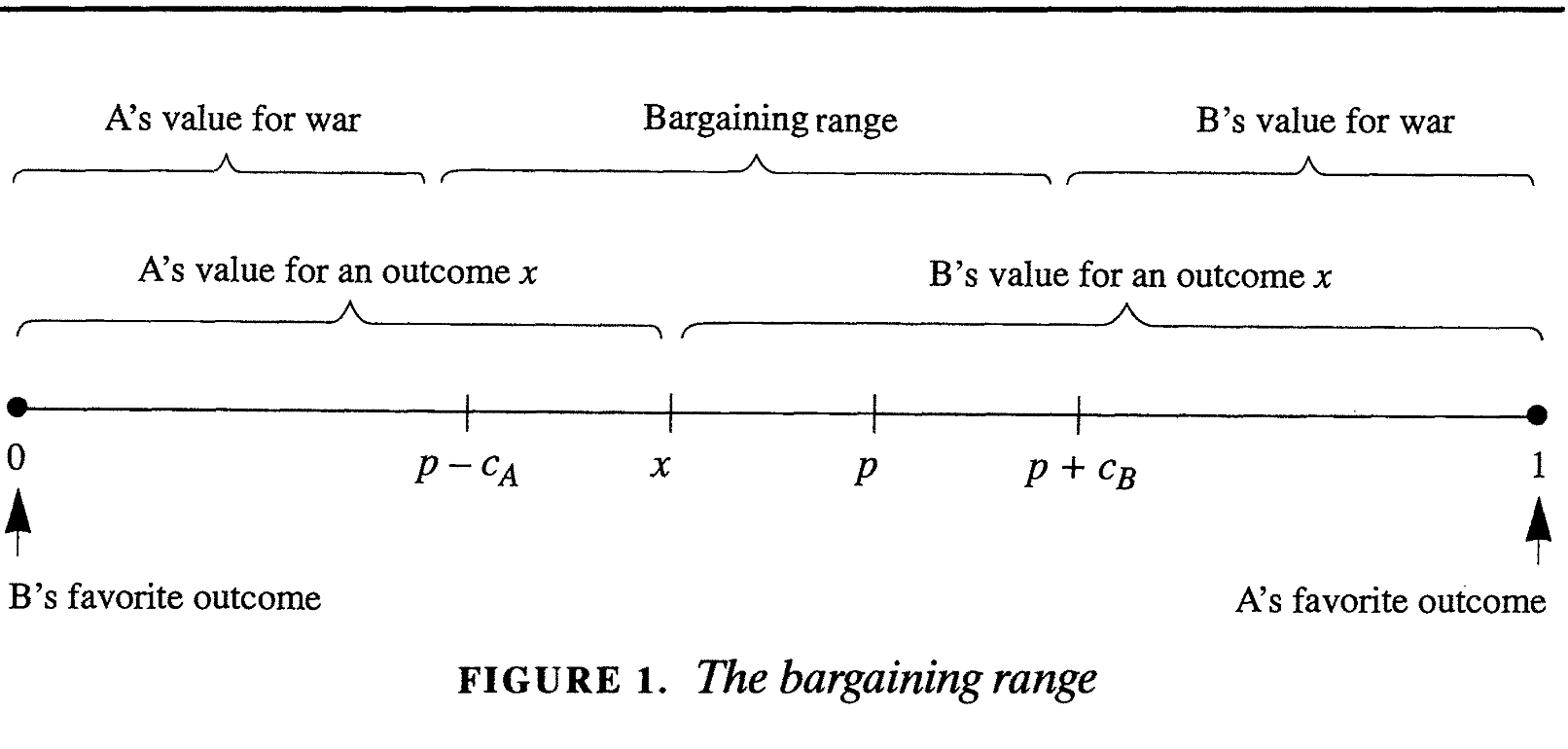
From Fearon, James D. “Rationalist Explanations for War.” International Organization 49, no. 3 (1995): 387. http://www.jstor.org/stable/2706903.
We will now explain these challenges step-by-step to contend why situationships are structurally problematic relationships that suffer from a high chance of going up in flames.
Indivisibility and Situationships
This issue really doesn’t require a lot of explanation, does it? Disagreements over unbargainable issues that are “core” to your person, your existence, are the most definitive way of killing a social equation. If the person I am engaged in a situationship with does not appreciate essential aspects of my personality, (for example, my sarcasm) then we are going to have a problem.
It is, of course, important to note that this issue is the death of any social interaction, be it a situationship, a relationship, or a marriage. I will, however, use this to support the general applicability of this theory.
Information Asymmetry, Different Expectations
This is the oldest tale in the sorrowful ballad of the death of romance. Bargaining breaks down and results in conflict due to incomplete information available to the parties involved. This incomplete information is understood by Fearon as capabilities and resolve. Sounds familiar?
The problem with the situationship is that there is fog with respect to the emotional capacity and degree of resolve persons have when it comes to engaging in the social equation, with no mechanism to regulate it. There is no foundation to the bargaining process itself, which triggers an “unbounded conflict”, something that attacks the very sense of existence of the social interaction itself. If one were to combine this absence of a framework with a difference in expected outcomes (commitment versus fling) or capacity (generous versus parsimonious), what we have is not dialogue, but destruction.
This is the point that distinguishes this sort of an arrangement from an established one. The situationship, unlike a more settled relationship, does not even have clear agreement on the foundational concept of what the engagement between the parties actually is. While the settled relationship would undergo the same bargaining process entailing both fog and the social conflict, there would be no asymmetry as to what this arrangement actually is. This makes it easier for the parties involved to establish the terms and conditions of coexistence within the framework and also helps them regulate and even mitigate the fog that surrounds the challenges of resolve and emotional capabilities. The relationship, unlike its counterpart, does not flail around like a detached twig in the slightest of breeze as a result of “bounded conflict.”
Commitment Issues
The commitment issue in a situationship is a strange thing, for it is precisely here that these social arrangements are born and killed. The situationship, by design, is meant to leave things open, to avoid a case of commitment to something these parties would not want to be tied into for a long run for a host of reasons that I will not care to comment upon.
Given this, it is natural to expect situationship-ending dynamics to show up once there is enough conflict to drive an “exit” from the engagement. Furthermore, it is not unreasonable to expect the lack of commitment to the engagement as the reason behind the conflict itself. Of course, things would be different if there was a deliberate attempt by both parties to keep the engagement non-committed. But as the introduction to this discourse established, this article is not about such an unrealistically happy-go-lucky class of people. Instead, it is meant for realistic cases where at least one party in a situationship expects something different from the other or from the relationship itself, which becomes aggravated by its casual nature.
Conclusion
This assessment makes one case clear. Situationships suck. The social arrangement of romance hopes to maximise happiness and minimise pain. The situationship creates fertile grounds for the maximisation of pain and the minimisation of happiness and satisfaction in realistic circumstances.
This is, of course, not a deterministic approach, but one based in firm opinion, reasoned speculation, and a theory that is seminal to the approach of conflict in international relations. Nevertheless, if the readers of this work find that violence has been unjustly inflicted on the concept of non-committed romance or on their emotions, we offer two options. First, that you respond in comment or rebuttal. Second, you roll said discontent up and smoke it.
References:
From Fearon, James D. “Rationalist Explanations for War.” International Organization 49, no. 3 (1995): 379-414. http://www.jstor.org/stable/2706903.