


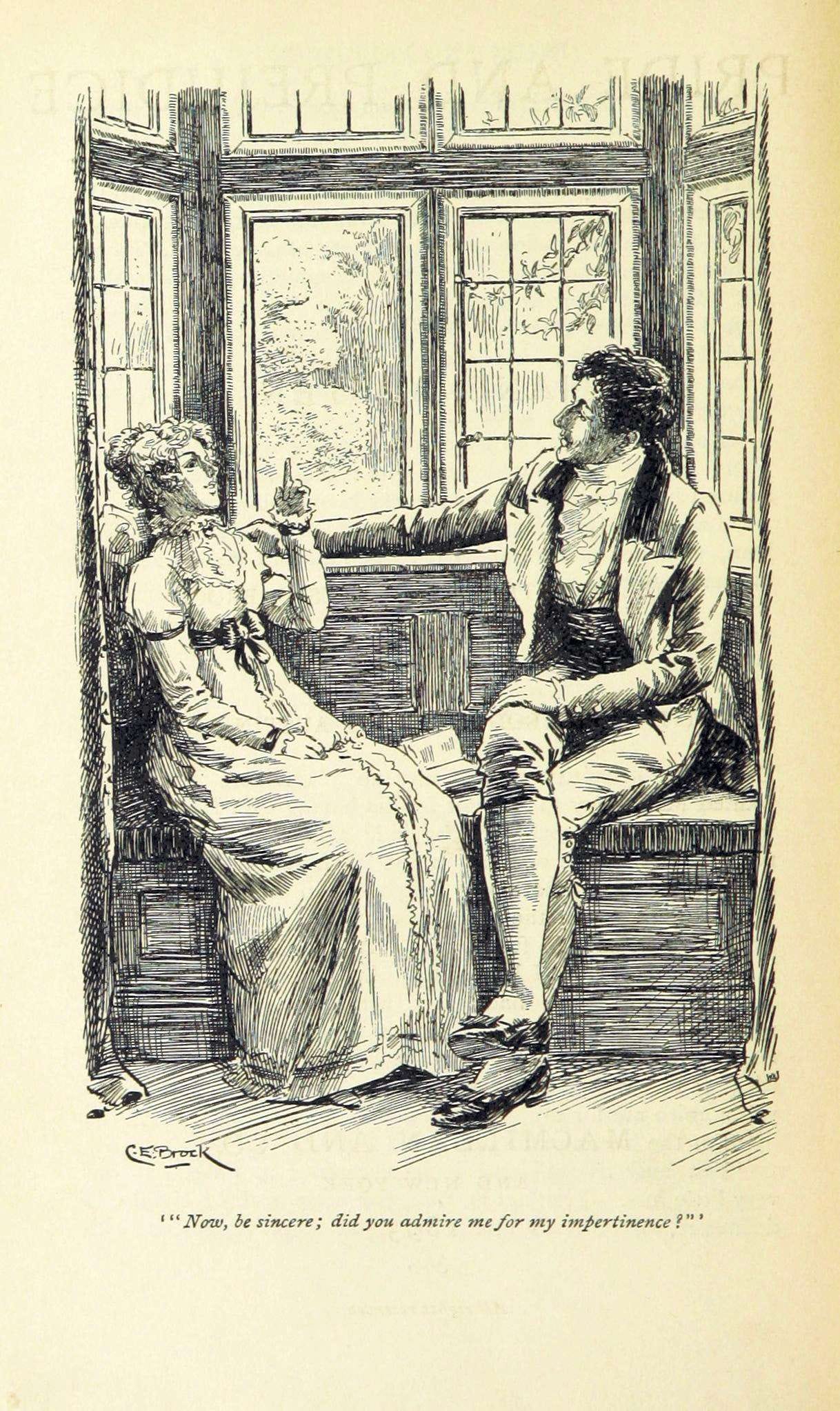
Illustration for Jane Austen’s “Pride and Prejudice” by Charles Edmund Brock, Public domain, via Wikimedia Commons
Indeterminate Feelings and Absolutely No Risk
When the term “situationship” was first introduced in 2009 by relationship and lifestyle blogger Demetria Lucas, the label was reserved for those who were in a “situation”, rather than a “relation”, where “casual sex led to confusion and emotional distress”. Since then, the term has come to serve as an iconic artifact of Gen Z’s struggle with long-accepted notions of dating standards and dating culture. Whether it’s the girl you keep making eye contact with in Libs, or that mysterious nerd in glasses who somehow always sits across you at Nummit, the situationship has widened its embrace to include nearly every relationship that would have previously been described as “it’s complicated.”
Given that Generation Z grew up with more social media access than any generation before, it is understandable that the “Anxious Generation” is also the most risk averse compared to any generation before. As studies and surveys show a reduction in risk taking — we drink less, drive less, and play less sports than our predecessors — it is no wonder that Gen Z are so enamored with the new label on the block. In a time where a failed pick-up line will crucify your Instagram handle through Close Friends stories and where asking “what are we” is like trying to defuse a bomb as a colorblind marine, it’s evidently hard to commit and just far easier to just stay in ambiguity.
As certified sexologist Myisha Battle wrote for TIME magazine, “Situationships aren’t for everyone, but they can be a way to give yourself more grace when searching for what you are looking for … While you both enjoy spending time together, learning more about each other, and continuing to define what you both want, you can experience intimacy that doesn’t need a reason.”
And yet, while there may indeed be plenty of utilitarian reasons to accept and even promote situationships — shared meals, shared occasions, and possibly even shared rent — it would be a harder leap of faith to assume that every participant in a situationship solely joins for the flexibility. To knowingly enter into a situationship with mere hopes of it magically growing into a relationship seems to ask of a situationship to provide both specificity and feelings — a proposition that my Relationship Postulate explains as being simply impossible in equally high amounts.
The Dynamics of Uncertainty: Physics’ Applications in Modeling Situationships
When German physicist Werver Heisenberg set out to publish his 1927 paper on quantum mechanics, he perhaps only sought to settle the “battle of opinions on the theory of continuums and discontinuums, corpuscles and waves.” In essence, Heisenberg was trying to bridge the gap between the work of James Maxwell and Albert Einstein. Little could he know, his groundbreaking work would be used nearly a century later to model something far more complex than quantum mechanics: the 21st century idea of the “situationship.” An impossible enigma, but with Heisenberg’s model, I may just be able to resolve the ‘battles of opinion’ surrounding “situationships” that have embroiled our generation’s dating discourse.
The Love Postulate to the Heisenberg Indeterminacy Principle
What the love-blinded romantic misses, the jaded poet remembers. And where the glazy-eyed physics student has zoned out, the professor will continue on teaching. Mathematically, the Heisenberg Indeterminacy Principle relates the confidence of a particle’s position and a the confidence of a particle’s momentum (that is, the velocity times its mass) to a reduced form of Planck’s constant (ħ = h/2π, or 1.05410-34 J s) such that the certainty of a particle’s position and momentum are inversely related. In other words, the more sure we are of a particle’s position, the less we are sure of its simultaneous velocity. Note that since a particle’s mass is constant, velocity and momentum are directly correlated and effectively interchangeable for the purposes of this article.
Heisenberg’s Indeterminacy Principle:
σxσp ≥ ħ/2
One may now see how this mathematical relation applies to a term as nebulous, as indeterminate as a situationship: just as position and velocity are properties of a particle, so too are specificity and feelings critical properties of any relationship. That inverse correlation — where an increase in specificity translates into a decrease in feelings, and vice versa — maps specifically onto situationships. With regards to particle physics, Heisenberg postulates that this basic uncertainty is more than simply a mathematical connection, but also an inescapable, intrinsic fact about particles and their existence. As I will later define, uncertainty also exists as a foundational part of what makes a situationship a situationship.
My proposal, the ‘Relationship Postulate’:
σspecificityσfeelings ≥ R
where R is some risk tolerance constant.
Conclusion: Intrinsically Uncertain, Certainly Inadvisable
In all the ways that romantic and sexual relationships offer security and comfort through consistency and predictability, situationships, definitionally and intrinsically, cannot offer the same. Any attempt to ascertain such predictability from a situation are therefore made in vain. If the fundamental machinery of the situationship is already biased towards uncertainty, then the whole ideology of the situationship is flawed. No matter how hard one tries, one cannot make a situationship certain when the situationship itself was founded on uncertainty as its originating ideal.
When viewed through the proposed physical model, situationships are a horrible deal, exchanging both clarity and maturity of feelings for short-term intimacy and little chance of escaping the dynamics of uncertainty. It is my opinion that situationships are never advisable to enter if one hopes to establish a defined relationship later on with the same person. While the heart may certainly argue that any intimacy is sufficient for the moment, it is the mind that must understand the terms and conditions of such cheapness.
