
Editor’s Note: This article is part of The Davidson Lux’s upcoming print edition, releasing next week. It is published here as an early preview.
“A free speech conference? You’re just walking into a room of conservatives.”
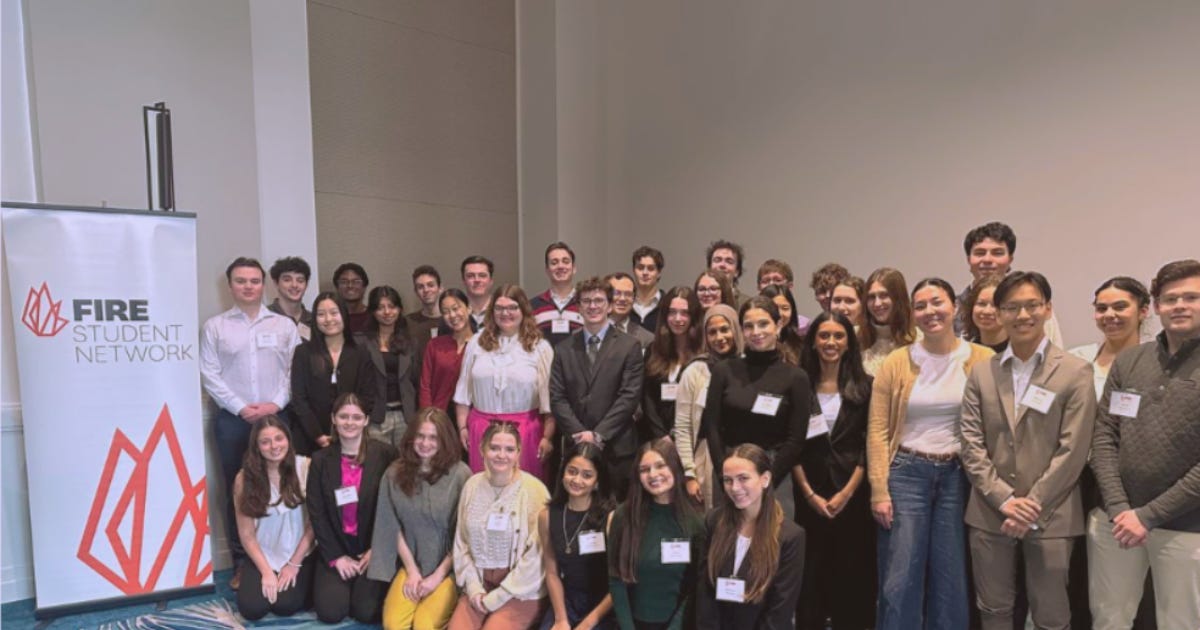
My roommate said that when he heard I was flying to a conference hosted by the Foundation for Individual Rights and Expression (FIRE), the same organization that gave Davidson a D for its speech policies. The assumption wasn’t unusual. Not long ago, a reader told me that simply using the phrase “the free marketplace of ideas” made me sound like a conservative.
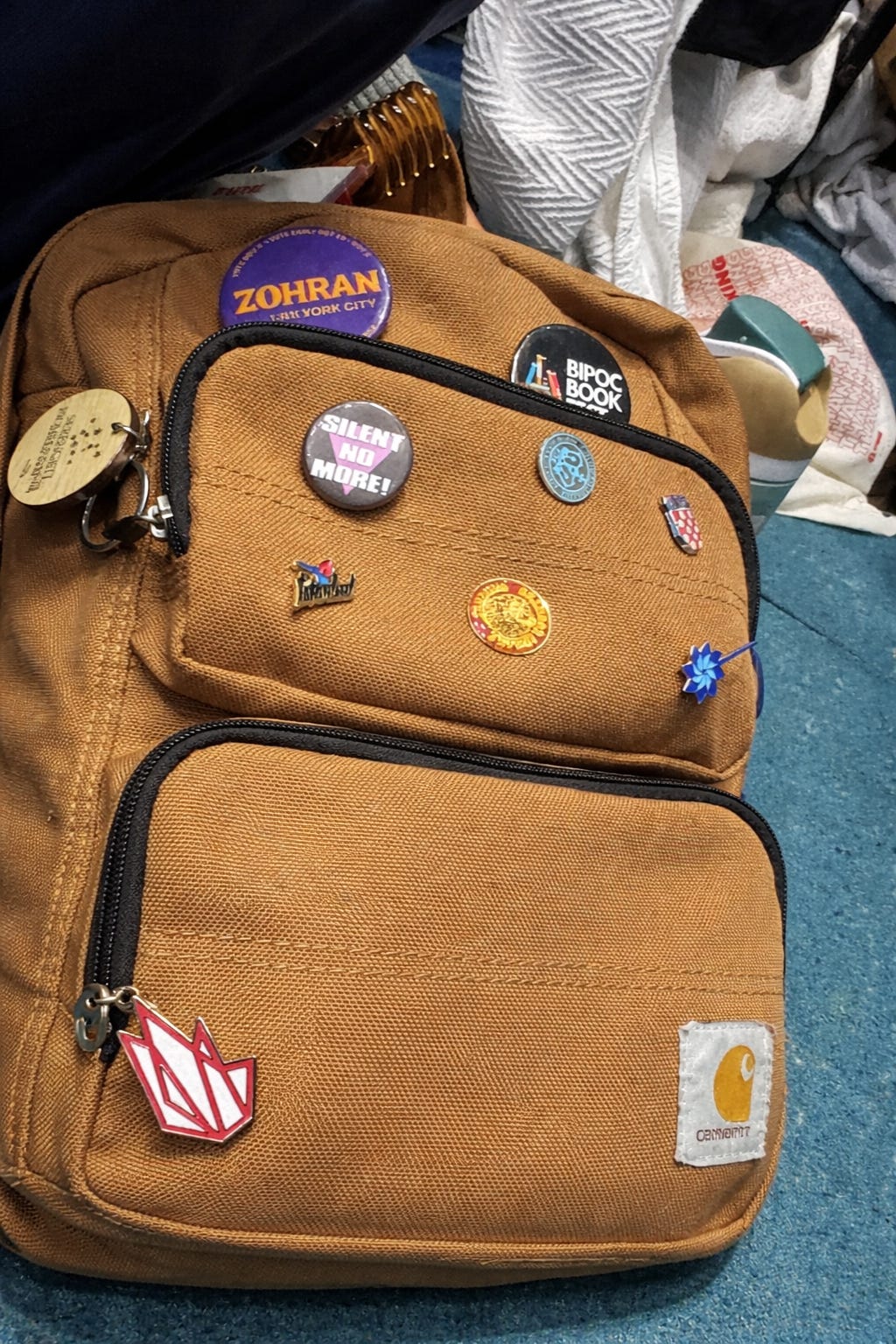
When I entered the conference room, the first student I noticed made me do a double-take. A glossy FIRE badge was clipped to her backpack, surrounded by other pins: BIPOC. Zohran for Mayor. By any definition, she was not a conservative.
She wasn’t the only one. Throughout the conference, I met students whose politics didn’t fit the stereotype my roommate had imagined.
“When I tell people I go to free speech conferences, they assume they’re conservative,” said Scott McKaughan, a student at the University of South Florida. “But they’re actually pretty nonpartisan. If anything, they usually lean left.”
Matthew Allaire, a senior at Macalester College who has attended several FIRE conferences, said the growing interest is largely a reaction to increasing political pressure on universities.
“I’ve been to several FIRE conferences in the past few years, and I’m seeing more students from elite institutions,” Allaire said. “That’s no mistake. The White House has singled out a lot of universities in its higher education reform agenda, and a lot of young people feel motivated to defend what they see as the bedrock principles of American democracy.”
Many of these students became interested in free speech well before Trump’s second term.
Ariona Cook, a junior at Duke University, traces her interest to the aftermath of George Floyd’s murder in 2020. “My small rural community in Kansas tried to organize a Black Lives Matter protest, and there was a lot of pushback,” she said. The protest was organized by community members, with the cooperation of the local police department, but tensions in the town remained high. Cook recalled that a couple that attended the demonstration were harassed at a bar later that night after being recognized.
Caroline Pope, a senior at the University of South Florida, entered the free speech movement long before college. As a high school journalist, she tried to write an opinion piece arguing that her school’s dress code was sexist. The article had already been approved by the student editor and faculty adviser when the principal intervened. Pope was called into the office and told the piece could not run because it would make the school “look bad,” and donors read the newspaper.
“I remember thinking, I’m being censored over an opinion piece in high school,” Pope said.
The experience sparked a lasting interest in student speech rights. Now at the University of South Florida, Pope serves as president of the Civic Discourse Club and works with FIRE to promote open debate on campus. In the wake of campus tensions following the October 7 attack, she says universities need stronger protections for expression — and more spaces where students feel comfortable voicing their convictions.
Samuel Conway, a Penn State student and former intern with the Foundation for Individual Rights and Expression, sees the challenge on his campus somewhat differently. At Penn State, he said, the obstacle is often less censorship than indifference.
“Penn State is a sort of bubble,” Conway said. “People aren’t necessarily concerned with the social and political things happening in the world.”
Conway said he was struck by the campus’s apolitical culture when he first arrived and set out to challenge it. For him, free speech advocacy is not just about protecting controversial ideas but encouraging students to engage with them. Universities, he argued, should be places for intellectual and political exploration, not merely pipelines into the workforce.
But for many of the students at the conference, apathy was only part of the problem. When students did become politically engaged, they often found themselves confronting a university culture uneasy with conflict itself.
Cook, the Duke junior, said that unease often appears in the form of administrative protest rules. At Duke, she said, university officials have adopted policies requiring demonstrations to be registered in advance and limiting disruptive protests. To her, that misses the point of political action. Demonstrations, she argued, are often meant to respond in real time to unfolding events, not to be folded neatly into an administrative process.
Allaire, the Macalester senior, sees the same tension on a broader scale. In the aftermath of the Gaza war and the congressional hearings that put university leaders under national scrutiny, he said, colleges have faced mounting pressure to reconcile competing demands: free expression, academic freedom, student safety, and political backlash from outside the university.
That pressure, he suggested, has only sharpened the stakes of campus speech debates.
“I believe in the ideals of the pursuit of truth, the pursuit of knowledge, and open inquiry,” Allaire said. “Those should be core missions of American higher learning. And every year it seems like we’re straying further from that.”
The pressures students described were not confined to one ideology. Jonathan McCartney, who began college at Colby before finishing his degree at the University of Florida, said that as a conservative student he often found himself on the receiving end of backlash. As a freshman writing opinion pieces for the student newspaper, he drew intense criticism for his views, including social media campaigns in which other students circulated material from his online history and denounced him as a fascist or white supremacist. What troubled him most, he said, was not simply that people disagreed, but that they seemed uninterested in arguing with what he had actually written.
Yet the conference itself, full of First Amendment advocates, offered a glimpse of the kind of debate many of the students wanted more often on their own campuses.
On the final night, long after the last panel had ended, clusters of students lingered in the hotel corridors arguing about politics. Among them were Cook and McCartney, who disagreed sharply on most issues and had supported different candidates in the 2024 election. As the hotel staff began ushering people out of the space, the two were still deep in discussion, debating California’s homelessness crisis and what governments should do about it.
The conversation was spirited but never hostile. There were no moderators, but neither interrupted the other. They listened closely to every point and continued long after everyone else had begun packing up.
Earlier in the conference, as we wandered through Disney World between panels, Scott McKaughan offered his own explanation for debates like that.
“The eternally radical idea is love your enemy,” McKaughan said. “Free speech is a manifestation of that in politics.”