

'The Future of Free Speech' Review: The Censors’ Trap
As censorship fails to stop authoritarianism, democracies are sliding into a free-speech recession.

Donald Trump built his comeback on a promise: he would be the free-speech champion the left refused to be. The executive order he signed on his first day, “Restoring Freedom of Speech and Ending Federal Censorship,” quickly looked more like a press release than a governing principle. His administration moved to deport noncitizen students for protected pro-Palestinian expression. His FCC chair, Brendan Carr, threatened ABC’s broadcast license over Jimmy Kimmel’s comments about Charlie Kirk’s assassination. Trump himself filed a specious $10 billion defamation suit against The Wall Street Journal, only for a federal judge to dismiss it a few days ago. He campaigned as a restorer of free speech and, once back in office, started acting like one more politician who likes liberty best when he does not have power.
Jacob Mchangama and Jeff Kosseff’s “The Future of Free Speech” explains why this pattern keeps recurring. Politicians invoke free speech when they are out of power and narrow it once they have some. University leaders suddenly discover procedural nuance only when they are cornered in a congressional hearing. Democratic governments praise open debate while steadily carving out new exceptions to it. But hypocrisy is not the book’s main subject. Its real concern is free-speech pessimism: the growing belief that open debate is simply too dangerous to leave alone. Before Trump promised restoration, universities had already trained students to self-censor, employers had turned speech into a reputational risk, and the Biden years had supplied their own examples of speech panic, from the Disinformation Governance Board to pressure on platforms to take down posts. Censorship rarely ends with the people who first justify it. More often, it creates the backlash that empowers the next censor.
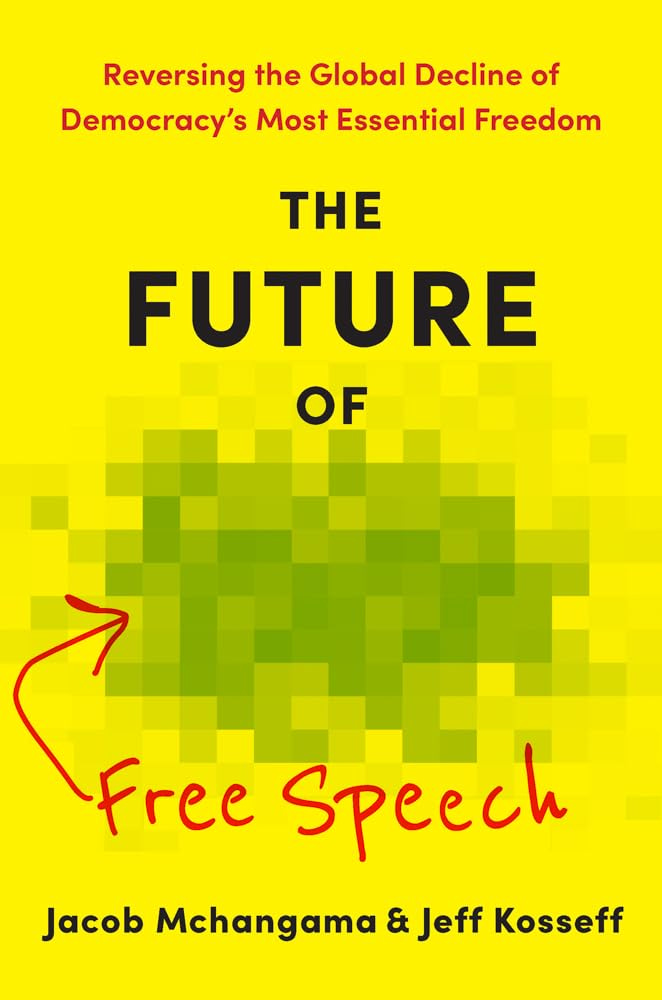
The book’s central argument is that we are living through a “free-speech recession.” The second half of the twentieth century was a golden age, when democracies were principled that liberty required broad protection for dissent, criticism, and open argument. That time is now gone. Drawing on Freedom House data, the authors note that roughly 6.3 billion people in eighty-one countries experienced a decline in freedom of expression in just ten years. Internet freedom has declined for fourteen consecutive years. Pew found in 2023 that 55 percent of Americans support government restrictions on false information online even at the cost of free expression, up from 39 percent in 2018. Mchangama and Kosseff argue that America’s free-speech tradition is now under greater threat than at any point since the Second Red Scare. This is not a book about dictators doing what dictators do. Its subject is the spreading conviction, even inside liberal democracies, that open debate is too risky to leave alone.
The book’s moral center is not built around the hateful men who populate some of its most memorable chapters, but around the people who most needed the right to speak. Frederick Douglass published an abolitionist newspaper while the postmaster general intercepted his mail. Eleanor Roosevelt fought to make free expression a universal human right over the objections of governments that preferred silence. Nelson Mandela argued from the dock at Rivonia that the right to speak was inseparable from the right to be free. Mchangama and Kosseff invoke these figures not as decoration, but as proof. The people who most needed free speech were never the powerful. They were the people the powerful wanted silenced.
That is why the chapter on the Four Hateful Men lands so hard. The speakers at the center of those cases were racists, bigots, and provocateurs, nothing like Douglass or Mandela. Yet the precedents advanced the rights of the very groups they despised. Terminiello v. Chicago, a case defending an anti-Semitic priest’s right to deliver a hate-filled speech to an angry mob, was later cited to overturn the convictions of 187 Black students arrested for peacefully protesting segregation at the South Carolina state legislature. Critics like law professor Mary Anne Franks argue that the First Amendment has been hijacked by a white male supremacist agenda. The historical record says otherwise. The ugliest cases built the legal floor that the civil rights movement stood on. Rights that depend on the moral appeal of the speaker do not remain rights for long.
That tension lies at the heart of the book. Two democratic instincts are in conflict, and they have been for decades. The first is the Jackson instinct. Justice Robert H. Jackson prosecuted Nazi war criminals at Nuremberg, saw Julius Streicher sentenced to death for propaganda, and came home convinced that democracies could be too trusting of dangerous movements. In his Terminiello dissent, he warned that the Constitution is not a suicide pact. The second is Justice Louis Brandeis’s instinct: that the answer to bad speech is not enforced silence but counterspeech, civic confidence, and the marketplace of ideas. Mchangama and Kosseff write squarely on Brandeis’s side, and their European chapters supply the evidence. Censorship does not simply threaten liberty. It backfires, hardening grievance and handing the next censor a ready-made justification.
That backfire effect runs through every country they examine. Germany, France, and Britain have all built expanding regimes of hate-speech laws, anti-extremism rules, and anti-disinformation measures in the name of preserving liberal order through militant democracy. The returns, however, are weak. Germany’s NetzDG, aimed at forcing platforms to remove hate speech quickly, has been in force for years; yet right-wing extremist offenses still reached a new high in 2024. France had more than 20,000 people listed as security threats in 2020, then watched Marine Le Pen win 33 percent of the vote in the first round of Macron’s snap election. British police now make around 12,000 arrests a year for offensive online posts. The Dutch case is the starkest. When Geert Wilders was prosecuted for anti-Muslim hate speech in 2011 and again in 2016, his party surged both times and became the largest in parliament by 2023. These laws do not quiet extremism, restore trust, or reduce polarization. They expand the state’s authority over expression.
Germany supplies the book’s sharpest example of that danger. After October 7, crackdowns on pro-Palestinian activism reached not only extremists but Jewish critics of Israel. Iris Hefets, a Jewish activist born in Israel, was prosecuted under Germany’s anti-Semitism laws for protesting the war in Gaza and calling it a genocide. The state begins by claiming it is protecting minorities. It ends up using those same powers against the people it claimed to protect.
When democracies censor, they do not merely imitate authoritarian logic. They legitimize it. Two days after the EU banned RT and Sputnik, Russia blocked the BBC, Deutsche Welle, and Voice of America, citing the EU’s own rationale about false information and national security. In Hong Kong, the 2020 National Security Law that jailed Jimmy Lai borrowed the same language of public order that liberal democracies had spent years normalizing. Once democracies grow comfortable treating speech as a threat to manage, they hand authoritarians both the vocabulary and the excuse.
The book’s most interesting example is Taiwan. With China targeting the island with sustained propaganda, Taiwan has more reason than most democracies to panic about disinformation and foreign influence. Yet it has largely resisted the European path anyway. Rather than build a censorship regime, it leaned into radical transparency, rapid public communication, and civil-society fact-checking. Digital Affairs Minister Audrey Tang’s formulation is the book’s best line: make the state transparent to citizens, but never ask citizens to be transparent to the state. Openness is not a weakness. It is a democratic advantage. That model has a partial echo even on the platform most associated with free-speech absolutism. X’s Community Notes, where volunteers with opposing viewpoints must agree before a correction goes public, has proven surprisingly resilient. It has flagged Karoline Leavitt for falsely claiming that most Americans supported the war in Iran and former DHS Secretary Kristi Noem for misrepresenting ICE’s killing of Alex Pretti. Its most unintentionally revealing validator may be Elon Musk, who ranks forty-third on his own platform’s Community Notes leaderboard.
The weakness of “The Future of Free Speech” is not that it lacks seriousness or candor. Mchangama and Kosseff do not pretend to offer a magic bullet, and they are right to reject the fantasy that censorship can solve democratic disorder. Still, the book is far more persuasive in diagnosis than in blueprint. Its practical alternative leans heavily on Taiwan, which it treats not just as an illuminating exception but as a prototype. That makes the case both stronger and more vulnerable: stronger because Taiwan shows that democratic resilience need not depend on censorship, more vulnerable because one unusually cohesive and geopolitically singular society can carry only so much argumentative weight.
The authors acknowledge that digital platforms bring out some of the worst parts of human behavior. What the book does not fully resolve is how its preferred remedies work in an online world shaped not just by virality, but by personalization. For curious people, this era is remarkable. Ordinary users now have access to more arguments, reporting, archives, and serious debate than any previous generation. But abundance cuts both ways. Large language models and recommendation systems do not just spread falsehood faster. They can generate tailored content that tells users what they already want to hear. That makes the problem deeper than ordinary propaganda. Community Notes and similar tools can help, but only up to a point. They can correct claims. They cannot make people want correction. Still, the alternative is worse. A government that protects citizens from being misled also claims the power to decide what they are allowed to hear. The best case for an open internet is not that it guarantees wisdom. It is that it keeps rival arguments and evidence available to anyone willing to look. That does not prevent democratic error. But it does make bad ideas harder to protect from scrutiny and easier to discredit over time.
The real danger, Mchangama and Kosseff argue, is not censorship itself. It is the confidence behind it. The people most eager to regulate speech rarely think of themselves as censors. They think of themselves as realists, managing risk, preserving democracy, and protecting the vulnerable. The book is a rebuttal to the belief, now common in both politics and academia, that free speech is a principle for easier times, a luxury once politics grows too volatile, too hateful, or too online.
“The Future of Free Speech” is strongest when it shows how censorship backfires. It is less convincing on whether counterspeech and transparency can hold up in an abundant information economy that rewards affirmation more reliably than judgment. That gap is real. But Mchangama and Kosseff’s larger point still stands. A free society cannot save its citizens from every falsehood before it is believed or every bad idea before it is tried. Some illusions collapse only when they meet reality. Democracies do not prove their strength by silencing what they fear. They prove it by refusing to panic and by allowing error to be tested in public.