
The Thursday before Thanksgiving break, the testing center was so crowded that my friend could not take her exam. She had studied and showed up on time, yet she was turned away at the door. Five years ago, this would have been impossible because the economics department did not use the testing center at all. Under the Honor Code, professors trusted students to take tests anywhere and at any time.
Today, assessments are administered differently. Monitoring has replaced discretion, and precaution has replaced assumption. Whatever its moral standing once was, the Honor Code no longer governs how exams actually work. The result is a system that frustrates everyone, even though no single person decided to build it.
Ironically, the clearest explanation for this came from my economics professor: game theory. The idea is simple. People make choices that depend on what they expect others to do. A choice is never just a choice. It is mutual guessing dressed up as decision-making.
To illustrate this, my professor used the classic Prisoner’s Dilemma. Two people are arrested. Each must choose whether to stay silent or confess. Cooperation produces the best joint outcome, but the rational individual’s move is to confess, because neither prisoner can trust the other.
The same logic now governs take-home exams at Davidson. The two players are the professor and their students. The professor can allow take-home exams or require the testing center. If the professor allows take-home exams, students gain convenience and professors avoid surveillance. But cheating becomes possible. If the professor uses the testing center, no one cheats, but every student bears the cost of coordination, scheduling, and stress. If the professor’s primary goal is to minimize cheating, the rational move is surveillance, even if it leaves everyone worse off than the trust-based system it replaced.
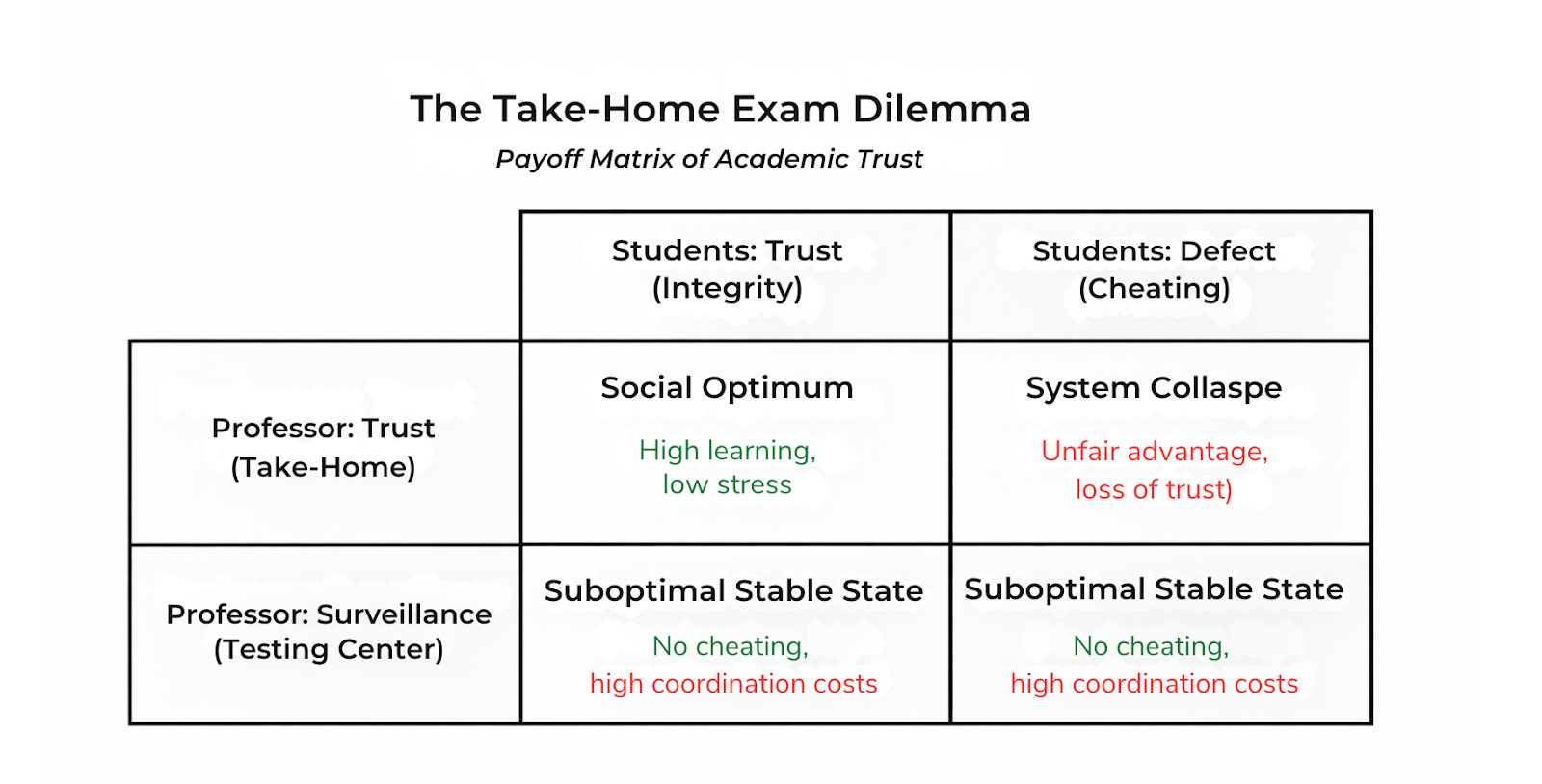
When a student asked how trust affects efficiency, my professor answered without hesitation: “The absence of trust is a cost to all of us.” The statement is general, but its implications are specific. Without trust, the cooperative option disappears. When professors cannot rely on students, surveillance replaces discretion. That surveillance then creates its own costs: administrative, logistical, and psychological.
The timeline is straightforward. Low trust leads to surveillance. Surveillance consumes time. Time cuts into teaching. Defensive behavior follows on both sides. The new equilibrium sustains itself.
In our class alone, we now take four major tests in the testing center and around 15 quizzes in the classroom. These quizzes often consume 30 of the 50 minutes of class time. Sometimes the entire period is lost. Just the quizzes totaled 450 minutes of class time across the semester, the equivalent of nine full class sessions that could have been used for instruction.
Davidson’s tuition is roughly $73,000 a year, which means each class costs about $9,000 in pure tuition. A standard class meets for about 2,250 minutes per semester. Our course spent 450 of those minutes on quizzes, or 20% percent of its instructional time. That is the equivalent of spending roughly $1,800 of tuition on administrative assessment rather than teaching.
The testing center adds its own layer of inefficiency. Professors forget to send tests, students miss time slots, and the schedule backs up. When I took my exam, it was the final day before Thanksgiving break, and almost every seat was filled. The environment is more stressful, especially for students who need accommodations, which can already be difficult to secure at Davidson. The clicking of pens, the squeaking of shoes, and the metallic clinks of water bottles make it harder to concentrate. Before this shift, a student could take an exam in an empty classroom and avoid these conditions entirely. Now, silence and focus are traded for noise and coordination.
The same dynamic appears outside of testing. Professors increasingly distrust students in group work, so projects now require check-ins, progress logs, and evidence that no one is free-riding. Once a few students defect, everyone is treated as if they might. The Prisoner’s Dilemma returns in miniature: nobody chooses the system, but everybody participates in it.
The relevant point is simple: it is implausible that students today are morally weaker than students five or ten years ago. Human character does not decay that quickly. The class of 2026 was not born with worse morals than the class of 2016. What changes is the environment. The expectations. The culture. When people believe others will cheat, they protect themselves. When they are treated as if they cannot be trusted, they act defensively. Fear becomes the new baseline expectation, and like any feedback loop, the low-trust equilibrium sustains itself.
At some point, genuine learning becomes secondary to its policing. A surprising share of an instructor’s time is now spent watching for defection: walking up and down rows, monitoring glances, and later reviewing assignments for AI use. When professors begin to view students as defectors, students view professors the same way. The shift does not arrive through one large decision, but through many small ones.
Game theory makes the logic blunt. When trust is high, cooperation is rational. When trust is low, defection is rational. Davidson once felt like a cooperative setting. Now it leans toward defection. Shared expectations have been replaced by proctoring, testing centers, and administrative controls. The institution did not choose this end state outright. It arrived there through small, local decisions that accumulated into a system.
Both sides now defect. Professors assume the worst; students respond in kind, and eventually the assumption becomes true. But if trust can disappear through small decisions, it can return the same way, not through a policy announcement, but through quiet choices to cooperate even when defection is available. Distrust wastes more than time. It diminishes the education itself. If trust ever returns, it will not arrive with ceremony. It will look like a professor handing out an exam and walking out of the room, and students choosing not to take advantage. That is how cooperation is built: one move, then another, until the high-trust equilibrium reappears.
this writer is so good , i can't wait until his next article
Very comprehensive article …. Well thought out ….. very professionally written