


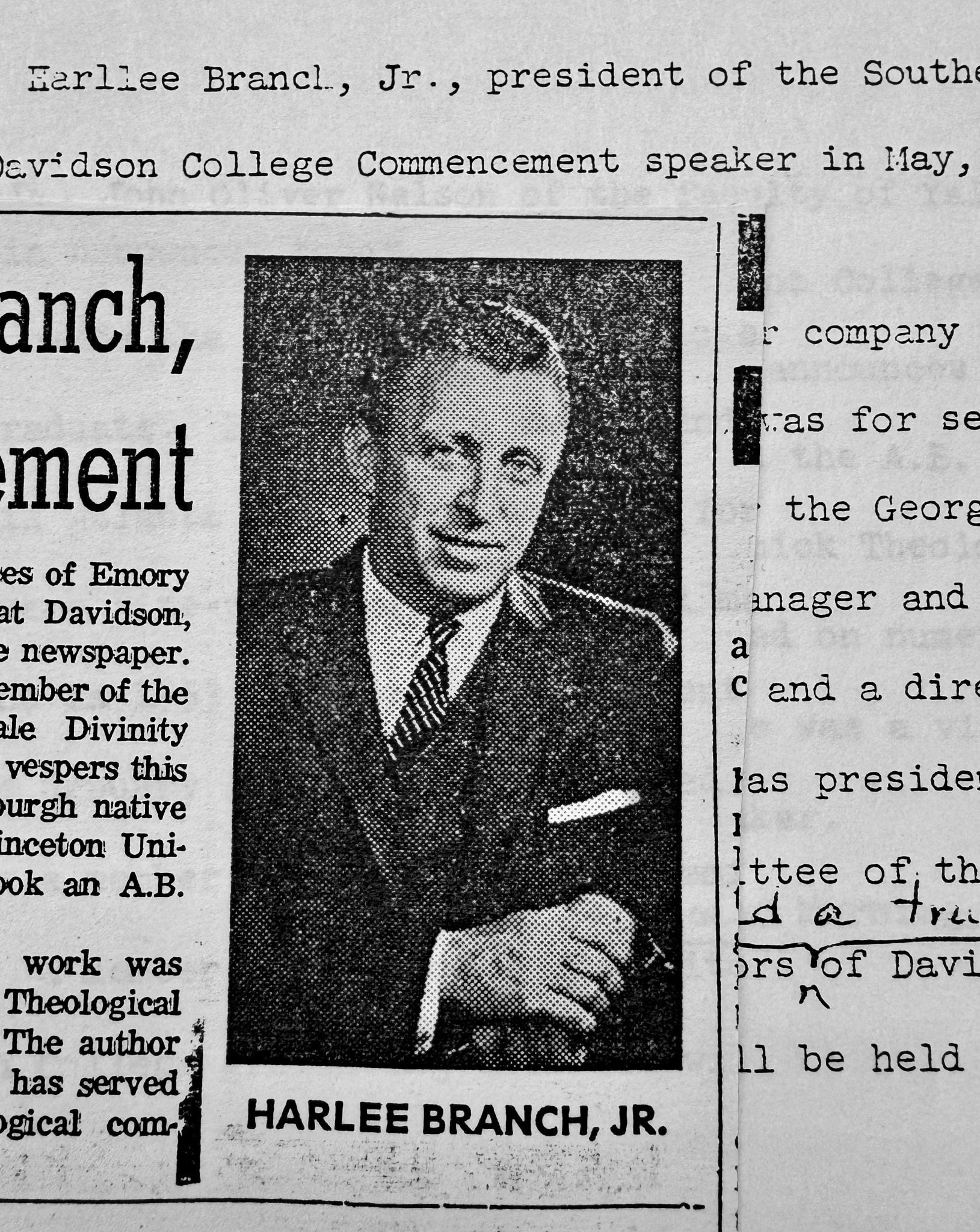
For more than sixty years, Davidson College has held its commencement ceremony without inviting an outside speaker to address the graduating class. The absence dates back to 1962, when Harllee Branch Jr., president of the energy utility giant The Southern Company, stepped to the podium and became, unbeknownst to him, the last guest to ever address a Davidson graduating class. His speech ran over an hour. The solution for most colleges would have been a fifteen or twenty-minute speaking limit going forward. Instead, Davidson decided to stop inviting speakers at all.
The conventional wisdom on campus ever since has been that a keynote speaker only prolongs an already lengthy ceremony and distracts from the graduates. In 2017, then-president Carol Quillen made that case in The Wall Street Journal, arguing that a shorter address from the college’s own president is more meaningful to students than a set-piece speech from an outside figure.
This is an understandable justification. But it rests on a custom born out of Mr. Branch’s speech alone, and it asks the college’s own president to fill a role that could be better served by a new voice and a fresh perspective.
Dean of Faculty Shelley Rigger, when asked about the current lack of guest speaker, cautioned that inviting a speaker means bringing in someone who will “either make the event about themself, or address themself to a generic student audience.” She noted that Davidson’s presidents, by contrast, have been with each class “through success and failure, joy and sorrow,” and that keeping commencement within the community “feels authentic and meaningful.”
She is not wrong that the focus of graduation should be on the Davidson community. The president speaks with an intimacy that an outside speaker cannot replicate, and that intimacy should be a distinguishing feature of Davidson’s commencement.
However, the problem with that reasoning is that the president has been speaking to us all for all of our four years at Davidson. They have welcomed us at orientation, spoken at several major campus events, written to us in many campus-wide emails, and, as Quillen herself acknowledged in her op-ed, many students often feel they have heard enough advice from her by the time commencement arrives.
A college president also speaks from inside the institution. Their job is to represent Davidson, which means their remarks are almost necessarily a celebration of the place and its values. While this serves a purpose in some part of the commencement ceremony, it misses out on what an outside speaker can offer. A president cannot easily tell graduates that parts of their education were incomplete, that the world they are entering will not reward many things they were told to value, or that they must stay wary of their instincts. An outside speaker, unbound from any institutional restraint, can do all of this and more.
Before 1962, Davidson proudly hosted several notable guest speakers at commencement, including James McCord, president of Princeton Theological Seminary in 1959; Luther Hodges, then governor of North Carolina, in 1960; and William Friday, president of the Consolidated University of North Carolina, in 1961. The following year, Branch, a Davidson alumnus, parent, and member of the college’s board of visitors and trustees, delivered a speech that stretched past an hour and into dinnertime.
In a 2002 email exchange between D.G. Martin ‘62, namesake of Davidson’s Martin Institute for Public Good, and Leland Park ‘63, Martin recalled that Branch’s address went on and on. Martin attributed the length to Branch trying to “pack too much” into his speech, compounded by a hot and humid afternoon that slowed him down.
“Of course, this all led to the wonderful tradition of NO SPEECHES at Davidson graduation,” Martin wrote.
The following year’s ceremony featured only remarks from Davidson President David Grier Martin, and every commencement since has followed the same pattern of the sitting president speaking in lieu of an invited guest.
Branch’s 1962 address, preserved in his book The Crowd and the Commonplace, is more provocative than sentimental, a rousing sequence of questions about religion and spirituality, politics, freedom, and the limits of knowledge. As a business executive, Branch spoke from a career-long opposition to communism and socialism, but also pressed the audience on whether the West’s commitment to freedom and free-market values was as steady as it claimed to be.
One of his many questions posed to the group of 200 graduates was whether the West truly wanted freedom, and “whether we really want it sufficiently to forego the easy, and sometimes enticing, compromises which make [freedom’s] maintenance impossible.”
This was also not the speech of a man trying to flatter his audience. Branch warned of a society drifting toward “mediocrity, monotony, and vulgarity,” and closed with a call to those graduates possessing “vision, courage, and hope” to venture forward and challenge the systems of their time. Colleagues described him as possessing an “amazing intellect” and an “extraordinary historical perspective.”
According to his son, Harllee Branch III, his father was deeply dedicated to the craft of commencement speaking, spending weeks or months carefully selecting and researching a topic that mattered to him. The Davidson address, in particular, was personal and, as his son described it, was “his love letter to the college that he loved so deeply all his life.” And love letters, he added, are “awfully easy to write far more pages than you should.”
The speech may have landed poorly for reasons beyond its length, though. The address itself contained none of the things a Davidson audience might have expected: no mention of the college, no warm recollections of his time on campus, no tidy piece of advice for graduates to internalize and carry forward.
But a speech like Branch’s is the kind of speech most worth giving. To leave a graduation with more questions than answers is one of the more honest endings a liberal arts education can offer. Four years of lectures and seminars are meant to teach students that curiosity should be an integral part of who they are, and that being a lifelong learner sometimes requires being made uncomfortable by people who have already lived with the questions longer than the graduates have.
Currently, Davidson’s commencement ceremony is pleasant and short, trading what could be a fascinating, longer ceremony for a safe, predictable one.
Davidson, like most small residential liberal arts colleges, is a bubble community by design. Students live within a roughly one-square-mile campus, eat in shared dining halls, take seminars of twelve students, know their professors’ spouses and children and dogs, and build a four-year social world dense enough that leaving it feels like a kind of emigration. This is, in most respects, a tremendous strength of a Davidson education. But it is a strength with a specific weakness: the bubble can make the world outside it feel simpler, or farther away, than it is. A graduation ceremony that sends students back into that outside world using only the community’s own voices is, in its own way, a final act of insulation.
Among peer liberal arts colleges, Davidson’s self-contained graduation is unusual. Williams, Wellesley, Amherst, and Pomona all regularly host keynote commencement speakers, each with a strong record. David Foster Wallace’s “This Is Water” address at Kenyon in 2005 has become one of the most-read commencement speeches in American history. In 2024, Lonnie Bunch, Secretary of the Smithsonian Institution, addressed the Williams graduating class to speak about how graduates can take their place in public life. And this year, the graduating class of Claremont McKenna will be hearing from Former United Kingdom Prime Minister Rishi Sunak and his wife, Akshata Murty.
Yet, a graduation speaker, by no means, must be of celebrity status. A Davidson alumna or alumnus with a distinguished career could return to campus and remind a graduating class what the next four decades might ask of them. A Charlotte or North Carolina leader, in business, government, medicine, or the arts, could speak to how Davidson fits into the life of the region, and why graduates might consider staying in the community that has given much to them.
There is a real opportunity in the fact that Davidson’s new Martin Institute for Public Good takes its name from D.G. Martin, a member of the class of 1962, the last class at Davidson to hear from an outside speaker at commencement. The institute exists to prepare students for lives of civic engagement, leadership, and public service, and is premised on the idea that democratic life depends on citizens willing to disagree in good faith. The Martin Institute cannot credibly tell its students that public life demands engagement with unfamiliar perspectives while the college’s most visible ceremony offers only the familiar ones they have already spent four years hearing.
Inviting a guest speaker, such as a judge, an organizer, a journalist, a foreign policy practitioner, a founder, or an alumnus whose career has taken them somewhere Davidson did not predict, would align the ceremony with the institute’s stated purpose of creating those who lead lives of leadership and service. It would also model, in front of parents, trustees, and graduates, exactly the kind of civic encounter the institute wants its students to seek out for the rest of their lives.
“A most pressing challenge of our times,” Branch told the class of 1962, “is to save mankind from the conceits and delusions generated by his vastly increased knowledge.” He said this to graduates stepping off campus and into the Cold War, the space race, and the early computer age. Yet he could have said it this spring, too.
Davidson’s students are leaving that bubble and entering a world that rewards certainty over reflection and speed over sitting with a hard question. Now more than ever, they need to hear, on the morning they leave, from someone outside the institution who can provide them this perspective. It is long past time we give Davidson its speaker back.