

This piece is published anonymously, and most of its sources spoke on condition of anonymity as well. The Lux is committed to holding its reporting accountable and to writers owning their work. For this story, though, sources could not speak with the same candor under their own names, so we are making an exception given what is at stake for them.
On August 15, Davidson’s International Student Engagement Office notified students that the College would be pausing all future Curricular Practical Training (CPT) authorizations and cancelling those approved.
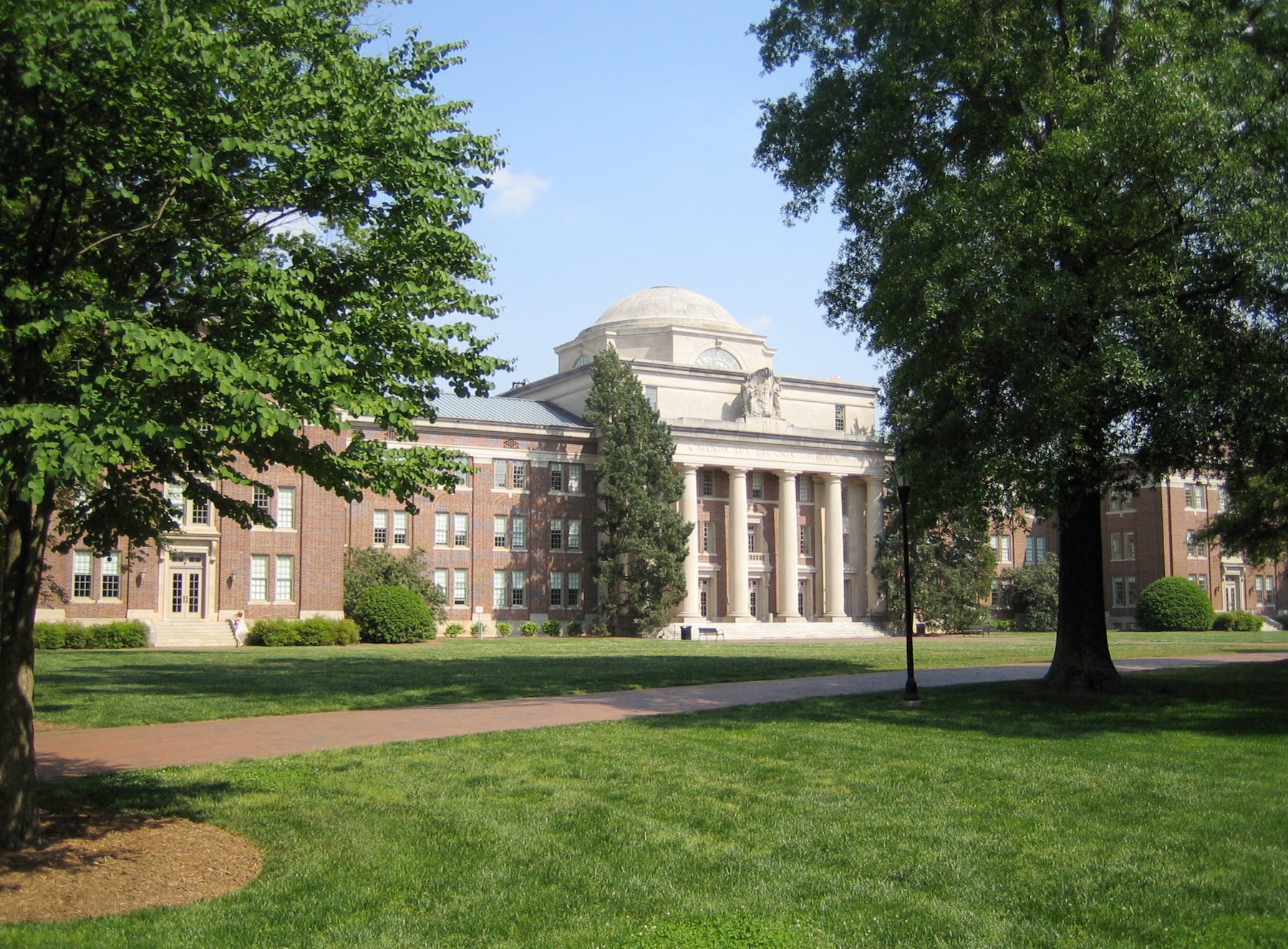
Chambers Building, courtesy of Wikimedia Commons
Without CPT authorization, international (F-1 visa-holding) students are legally barred from engaging in any off-campus internship or research in the United States. As The Lux previously reported:
“The policy change follows an August 12th broadcast message from the Student and Exchange Visitor Program, or SEVP, which oversees institutions enrolling F-1 students. The message did not rewrite the federal regulation governing CPT, which requires it to be ‘an integral part of an established curriculum.’ Instead, SEVP announced increased scrutiny of CPT authorizations and specified that CPT only be authorized when it is a requirement of the degree for all students in the degree program.”
Now, Davidson’s administration, faculty, and international student body are trying to cooperate and find possible solutions.
International Students Respond
Davidson’s decision has left some in the international body frustrated: “They’re thinking of this in the long term, which sacrifices those here,” a student remarked.
Another bluntly stated, “We’re highkey f***ed.”
Frustration was common among those interviewed, though most ultimately said they understood Davidson’s response.
“Initially, we thought Davidson was one of the only five colleges that paused the authorizations, but it turns out that a lot of schools have done that now. I think it is a conclusion across the board [that] Davidson just acted faster, because their class year starts earlier,” Davidson International Association (DIA) Vice President Amber Simnani said.
On the question of whether Davidson is coordinating its response with other colleges, Chief Communications & Marketing Officer Mark Johnson wrote to The Lux that member institutions of the Association of International Educators and Associated Colleges of the South (ACS) were discussing approaches. He also stated that the College works with lobbyists and consultants in Washington who examined the topic on the week of September 6th and continue to share information and ideas.
The reality remains grim, however. According to the National Association of Colleges and Employers’ 2026 Internship & Co-op Report, 63.1% of interns were converted into full-time hires. For international students, the reality is quite different: DIA President Murtaza Nikzad shared results from an international student survey in which 84% of respondents reported they had been dissuaded from seeking an internship or off-campus research opportunity, while 26% had an offer or were in an interview process that the CPT change prevented them from pursuing. As Murtaza explained, “This impact data was gathered from a whole lot of people from different majors: math, biology, economics, PPE, data science, chemistry, and more.” The regulations appear to have reached international students across a wide range of fields of study.
This Isn’t Isolated, But it is Different
The current federal US administration has a record of restricting international students. It has placed travel bans for students from over 20 countries, put a $100,000 price on the H-1B visa, and enforced strict social media monitoring for students seeking or maintaining a visa.
The international students that The Lux had spoken to unanimously agreed that the new CPT regulations were just another step in isolating them.
“It was obviously a shock, but at the same time it was like an anticipated shock, you know? Because I think this new CPT guidance is just one of the many acts that the federal agency has put in place to restrict international students,” says one member of the community.
Another student characterized the broadcasts and memos as a strategy borrowed from the idea of deterrence as put by the economist Thomas Schelling: the government isn’t taking a decisive step, but laying the groundwork and leaving the outcome to chance, a strategy that also shields the administration from lawsuits it couldn’t otherwise avoid. “This is no longer rule of law; this is rule by law,” the student said, arguing officials now hold a stack of regulations they can apply selectively, whenever it serves them, “and as a consequence, schools are deterred.”
Simply put, the federal administration has threatened to decertify schools that fail to comply, but it is unclear which schools might actually face that risk. For institutions such as Davidson, the risk of being dragged into a fight with the government or having students’ visas revoked outright is the critical decision-making factor. Therefore, such institutions have largely complied.
This seems to have been the exact rationale for Davidson’s immediate compliance. As Director of International Student Engagement Angie Edwards, wrote to The Lux in an email, “We recognize that this is disappointing and disruptive, but our immediate concern is ensuring that students remain in compliance with their immigration status.”
Working on Solutions
Although some have assumed that there is little being done about the issue, The Lux’s investigations have found the opposite to be true. As Dr. Shelly Rigger, the Vice President of Academic Affairs and Dean of Faculty, wrote in an email response to The Lux, “Everyone in administration is working together to get the best outcome for students. There is robust collaboration and cooperation across the different divisions of the college.”
Representatives from DIA met with President Douglas Hicks on September 8th to discuss the response. Simnani wrote after the meeting, “It actually contradicted the initial assumption that little is being done. In fact, it has become clear that the faculty actually cares a lot (and inadvertently the administration) beyond just a utilitarian cost-benefit perspective!”
So what are some possible solutions to help navigate the new regulations? One solution being floated is a Student Government Association bill recommending the addition of one required experiential learning experience to Davidson’s graduation requirements. While the bill itself would be non-binding, the faculty and administration might use it to debate an actual requirement. This would affect all students on campus, regardless of citizenship.
Another solution would be the creation of interdisciplinary majors or minors that could be designed by students in a way such that an experiential learning opportunity becomes required for graduation. “So far Dr. [Britta] Crandall seems to be very positive, but I think the CIS [Center for Interdisciplinary Studies] is also very cautious because they don’t want to do something that makes it seem like they’re trying to break the rules,” Simnani said.
Other efforts have focused on making on-campus opportunities more accessible. “We are just starting these conversations [regarding on-campus opportunities], but I know faculty will create as many on-campus opportunities as they are able to support – as they do every year! I am confident of that because Davidson has a good record of attending to students’ need for summer experiences,” Dr. Rigger wrote to The Lux. DIA is also working with the newly created Martin Institute for Public Good to take advantage of opportunities created by the initiative. Moreover, in a September 13th meeting with the general international student body, DIA representatives stated that they are also looking at expanding opportunities through the Jay Hurt Hub.
Even so, there is a sentiment that these are as Simnani described: “like putting bandages on the students that are currently here.”
Moving Forward While Facing the Consequences
The larger implications of the CPT policy have not been lost on students and faculty at Davidson. A faculty member described the current administration’s general policies as “anomalous” and said that the policy results in a “lose-lose” scenario. A student first-hand describes the effects: “I’ve already spoken to folks where I’m from, and they’re much more discouraged from studying here [the US]. I think that might be the point, the ideological result the administration is aiming for.”
There is also the important question of what those international students already here should do. As Simnani explained, “It’s a very difficult thing to process, just because students envision themselves doing that competitive investment banking internship or some engineering work for so long and now they can’t do it anymore. It has taken a toll on people’s mental health.”
Dr. Shelly Rigger wrote a message she wished to be included in full specifically regarding this question:
“I would recommend that all students — international and domestic — sit down with their advisors and mentors, including mentors in the Matthews Center, and have a deep conversation about their aspirations and life goals. What kind of person do you want to be? What problems are you hoping to solve? What kind of work environments appeal to you?
With those big questions in mind, students can talk to their advisors and mentors about the myriad opportunities Davidson offers for personal growth and learning, and how the full range of experiences can help students both build a resume and come to a better understanding of what they want out of life. Sometimes students get stuck on a relatively narrow path, thinking that’s the only thing that will get them where they want to go. I’m here to tell you: the world is bigger than you realize, and the narrow path is never the only one, and rarely the best one.”
Finally, there is increasing concern about how these policies affect free speech on campus. “There is a reason why I’m giving this interview anonymously. International students are scared out of their wits as of this moment to speak out in public. We need to be careful about our social media, what we speak, and who we speak it in front of” a student said.
Interviewees stated the need for unanimity: “Stay close to the international students, I suppose…this is a time for solidarity.” They also stated a need to be informed. “Honestly, the best thing I think any American student could do would be to remain informed and also just support international students.” Another emphasized, “Get to know the issue and speak up. We don’t have the First Amendment protecting us. You do. I understand the rational disincentive to not do anything about it. But this reflects a broader trend of crackdowns on the freedom of speech and expression across this country.”
Cooperation between the Davidson administration and the international student body is ongoing, but slow. The larger solutions, which are still only “bandages”, will have to go through the administrative process and could take semesters or even years. As the situation stands, Davidson international students are forced to sit with their hands tied as internship deadlines and their career prospects pass by.